
100-Piece Hair-Care Trio OEM: Balance SKU Roles and Reorder Timing
Plan a 100-piece-per-SKU hair-care trio with distinct product roles, realistic consumption, compatible stock packs and separate reorder decisions.
Direct answer
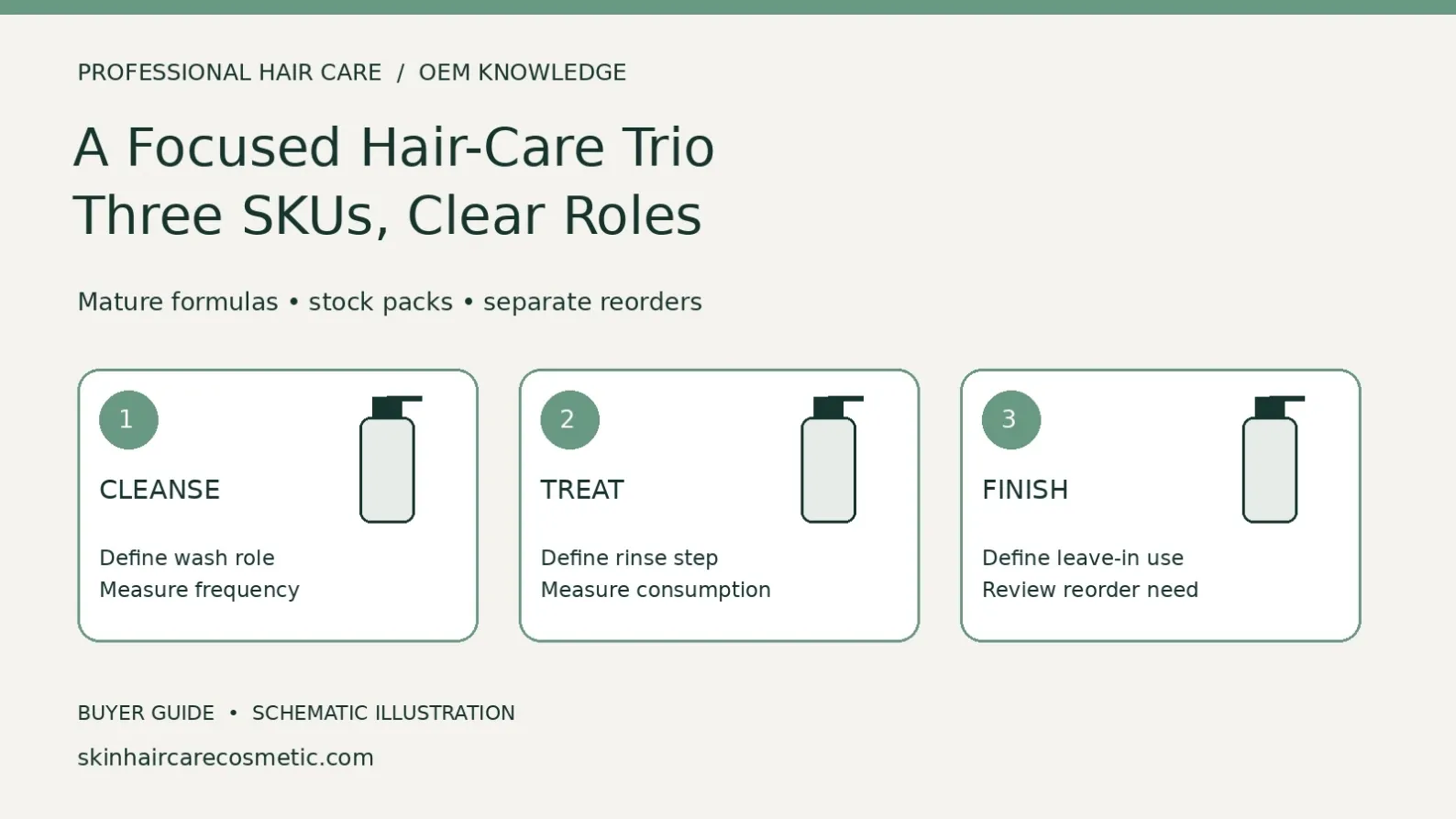
A practical small hair-care trio gives each SKU a separate job: cleansing, rinse-off treatment and leave-in or finishing care. Start with selected mature formulas and compatible stock packaging, then measure consumption and reorder demand separately. An initial 100-piece-per-SKU order does not imply that all three products should be reordered in equal quantities.
Why regimen clarity matters now
John Masters Organics' 29 September 2026 announcement presented cream shampoo, serum and mask as a coordinated premium routine. This is one brand's launch architecture, not proof that every three-product set sells better. Source: Brand release, 29 September 2026.
The useful inference for a small OEM project is that sequence can create a coherent proposition. Each product still needs an independent purpose. Three bottles carrying the same broad “repair” message can be harder to evaluate than three clearly differentiated tasks.
Build the role matrix before selecting fragrance
| SKU role | Question it answers | Evidence to record |
|---|---|---|
| Cleanser | What does the customer wash away, and how often? | Dose, frequency, rinse experience |
| Rinse-off treatment | Which hair-feel or manageability target follows cleansing? | Application time, rinse protocol, dry finish |
| Leave-in or finish | What daily or styling task remains? | Distribution, residue, reapplication |
Choose a conditioner or mask according to the intended routine. A weekly intensive treatment and a daily rinse-out conditioner have different consumption patterns even when their labels share a repair theme.
Use a redundancy check
For every proposed SKU, write its application area, use moment, primary benefit and consumer dose. If two products have nearly identical answers, ask whether one should be removed or reformulated.
An additional product earns its place when it solves a distinct use case. It should not be added simply because a competitor has a larger assortment.
Keep the first sample round narrow
Compare a manageable number of mature bases. Evaluate cleansing and treatment separately before testing the entire routine. Otherwise, a strong mask may hide an unsuitable cleanser, or a heavy finishing product may obscure a good rinse-off treatment.
Code the samples and record the combination used in each assessment. Approve the individual products and then assess the sequence at the intended doses.
Use a shared fragrance family only after compatibility is confirmed for each formula. Matching names do not guarantee matching odor in different bases.
Match stock packaging to use frequency
A coordinated appearance does not require identical closure types. Shampoo needs a practical cleansing-product dispenser; a thick mask may require a jar or suitable pump; a small serum benefits from controlled output.
Confirm bottle size, closure, decoration route, label dimensions and inventory reservation before preparing artwork. A proposed stock component can become unavailable before the order is finalized.
Avoid forcing every SKU into the same volume. Pack size should follow consumer dose, routine frequency, price position and component availability.
Reorder by SKU rather than by set assumption
During the pilot, record sales as individual products and as sets. Track which product is used fastest and which generates requests for replacement. Keep feedback about fragrance separate from feedback about performance.
For example, customers may finish shampoo while using a mask weekly and a serum in small doses. The next order might need different quantities. That is a planning scenario, not a universal consumption rule.
Review contribution margin separately for each SKU and for the bundle. An attractive bundle discount can conceal a component that is expensive to fill, ship or replace.
What the 100-piece route covers
Selected mature formulas using in-stock bottles may start from 100 pieces per SKU. Custom formulation, fragrance, color, bottle printing, special cartons and professional capacities are reviewed separately.
Compare the four-step daily-care set as a range reference, then select only the roles needed for your pilot. A reference range is not a requirement to launch every component.
Buyer FAQ
Must a hair-care trio include a mask?
No. Choose a mask or conditioner based on the target routine and user needs.
Should all three SKUs have the same size?
Not necessarily. Dose, frequency, price and compatible stock components should guide size selection.
Does 100 pieces mean 100 mixed pieces across three SKUs?
The quoted route is generally assessed per SKU. Confirm the exact quantity basis with the manufacturer.
Should the reorder repeat the initial quantities?
Only if sales and consumption justify it. Evaluate each SKU separately.
Project discussion
Send your target consumer, channel, three proposed roles, pack sizes and quantities through Contact. Request a focused formula-and-stock-pack proposal with a separate quotation for each SKU.