
What Does “Acidic” Mean in Hair Care? A Buyer’s pH Test Guide
Understand what pH can and cannot tell you about a shampoo, mask or gloss, and how to test the finished product on hair.
Direct answer: does a lower pH make a hair product better?
No single pH value makes every shampoo, conditioner or gloss better. pH affects the formula system and can influence hair-fiber behavior, but the finished product must also cleanse or condition as intended, remain stable, preserve properly and feel right on the target hair. Compare products under the same use protocol before attributing shine or reduced frizz to pH alone.
What the science supports—and its limit
A 2014 published review of shampoo pH discussed how alkalinity can increase negative charge and friction on hair fibers, potentially contributing to frizz and damage, while also noting that more studies are needed to establish an optimal pH range for scalp and hair. The paper does not provide a universal number for every modern formulation. A separate hair-structure study describes how conditioners use multiple components, including cationic polymers and silicones, to affect feel. This is why an “acidic” front label cannot replace finished-formula performance data.
Compare like with like
A daily shampoo, a rinse-off post-color mask and a demi-permanent gloss have different jobs. Write down the target pH range and measurement method for each finished product, including the temperature, dilution if any and calibration procedure. Test pH at release and after stability aging in the final pack. Check whether fragrance, pigment, active ingredients or a packaging component shifts the result over time.
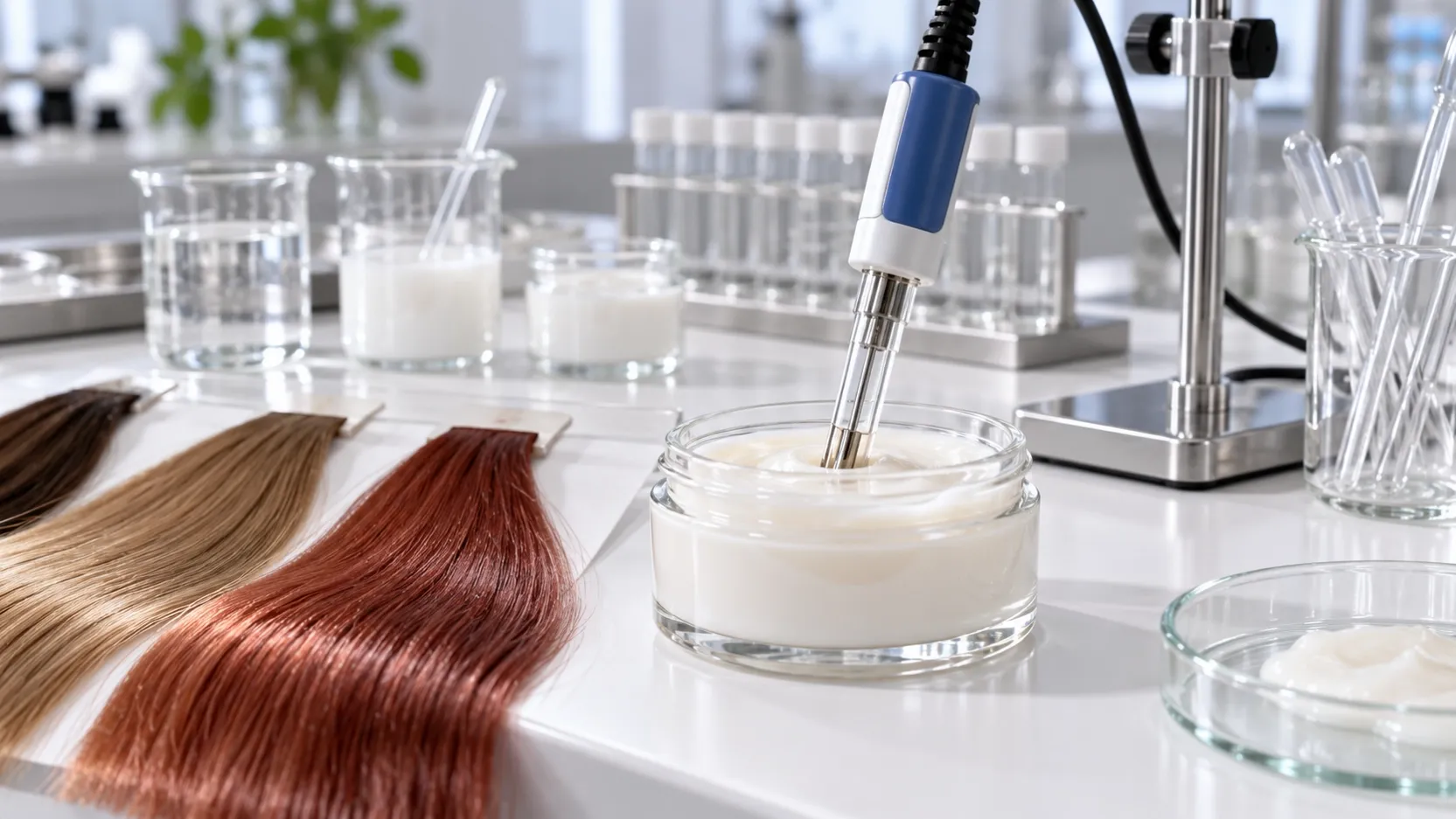
Use hair swatches with known histories—virgin, bleached and color-treated—and a fixed application dose. Record wet combing, drying time, shine under controlled light, roughness, tone shift and repeated-wash behavior. If a gloss uses colorants, assess shade and processing separately from conditioning feel. A low-pH mask may improve feel but does not, by that observation alone, permanently repair internal bonds.
Set claim language after the test
“Helps hair feel smoother after coloring” can be assessed with a panel and combing protocol. “Seals every cuticle” or “locks color for weeks” is far broader and should not be used without suitable evidence on the actual product. For professional color systems, coordinate directions with the selected color and developer; do not assume an acidic treatment is interchangeable with a neutralizing step after every chemical service.
FAQ
Should pH be printed on the front label?
Only if it serves the buyer and is measured consistently; it should not be the sole benefit claim.
Can an acidic mask replace a color gloss?
No. A mask can condition, while a color gloss may have a separate tone-deposit or demi-permanent purpose.
What should be requested from the factory?
The finished-product pH specification and method, stability results, pack compatibility, use directions and hair-performance test plan.
Related products and buyer route
Compare the professional acidic post-color repair mask with the acidic demi-permanent gloss and toner. Contact Junchun Cosmetic with the intended service, target country, hair history and claim wording for a technical sample brief.