
Beauty in the Motherland 2026: Turn Buyer Feedback into a Small Hair-Care Trial
Turn Beauty in the Motherland 2026 conversations into a focused hair-care trial using a clear user brief, coded samples and a realistic approval plan.
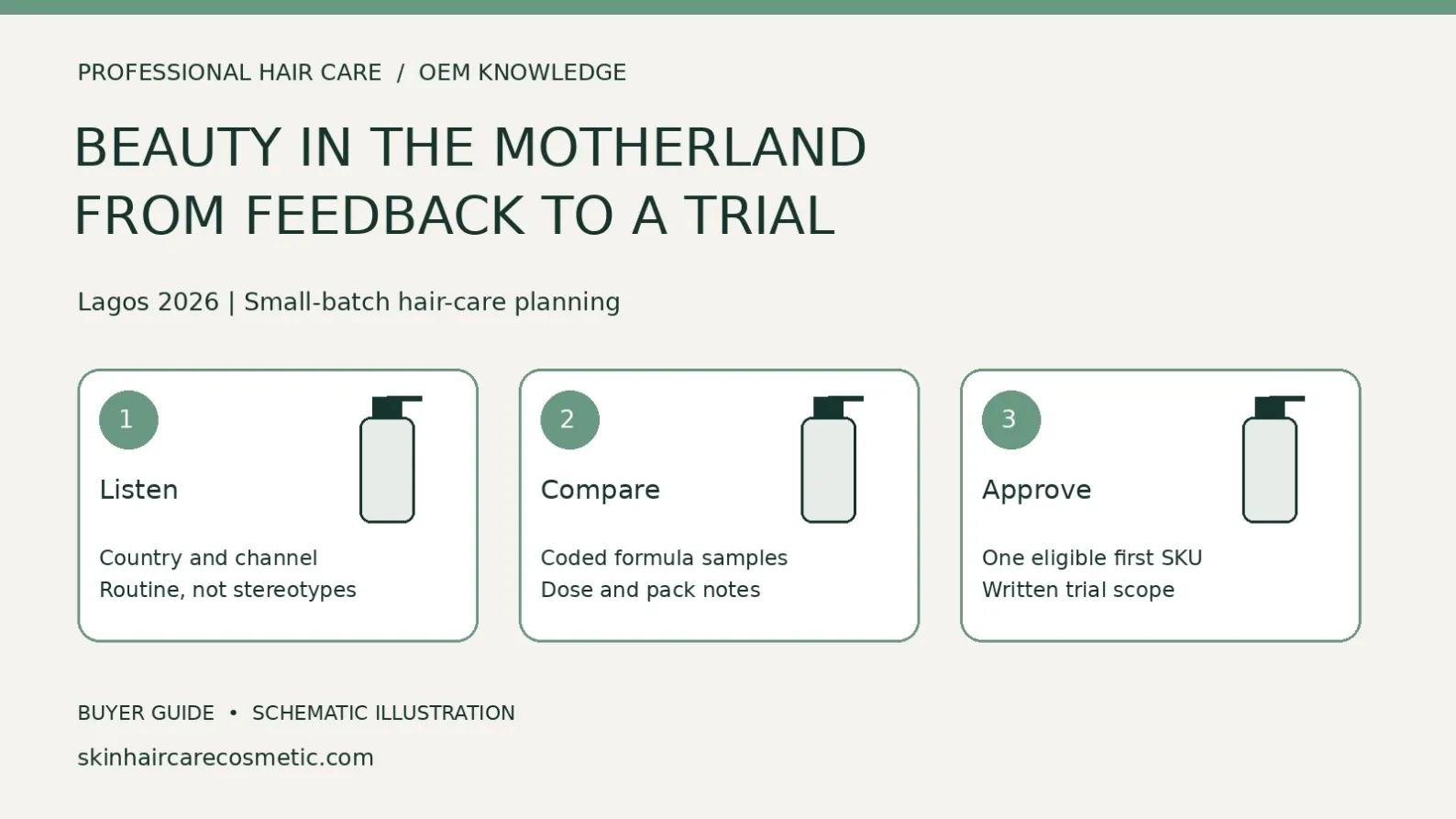
Direct answer
Turn an exhibition conversation into a useful hair-care trial by recording who will use the product, which routine problem matters and how the buyer will evaluate a sample. Choose an eligible mature formula and in-stock bottle only after those details are clear. Selected 100-piece orders can test a focused launch, but they do not replace formulation, safety or market-entry review.
The event context, without invented outcomes
Beauty in the Motherland's organizer lists 5–7 October 2026, at the Eko Convention Center, Victoria Island, Lagos. Official event page, checked 7 October 2026. Today's article prepares a follow-up process; it does not report audited show orders or imply that Junchun has a booth or attended.
Buyer inference: conversations around an event can expose specific product gaps, but they are often incomplete briefs. A buyer mentioning coils, braids or salon care has supplied a starting point, not enough information to choose a formula. Avoid treating Nigeria, West Africa or the African continent as a single consumer segment.
Capture the five details that change the sample choice
Ask for the country and sales channel. A salon purchasing for services evaluates differently from a retailer supplying home users. Record the intended hair routine and any relevant treatment history. Ask what the person currently uses and what they want improved. Then confirm the pack format and first-order budget.
Use a short form rather than collecting a long wish list. Examples of useful observations include difficulty spreading a cream at the intended dose, unwanted residue when used with a specific gel, or a closure that is inconvenient with wet hands. These observations tell the supplier what to investigate. A broad request for the best African hair product does not.
Keep statements and interpretation separate
| Recorded information | Useful follow-up | Avoid concluding |
|---|---|---|
| Buyer describes a heavy finish | Confirm dose, hair state and application | All users need an oil-free formula |
| Salon requests larger packs | Estimate dose and services per pack | A large format is automatically cheaper per service |
| Retailer asks for many fragrances | Ask which have paid demand | Every fragrance deserves a launch SKU |
| Buyer wants low MOQ | Confirm per-SKU scope and stock pack | All custom projects qualify for 100 pieces |
Compare samples before introducing branding
Give each sample a code and record its formula version. Use consistent instructions and ask testers to note the amount, application area and products used before or after it. Compare the intended finish, not a label story. Once a formula is provisionally preferred, assess it in the proposed filled bottle and repeat the practical use check.
Do not ask customers to test unreviewed experimental mixtures. The supplier should confirm that samples are suitable for their intended evaluation. If users report irritation or another concerning reaction, stop the trial for that user and escalate the observation rather than adjusting the fragrance informally.
A mature formula remains subject to final product, packaging and label review. Calling it mature describes the development route; it does not mean that every new fragrance, bottle or market-specific claim is already approved.
Build a first order around one clear question
An eligible 100-piece order is most useful when the question is narrow: will the proposed customer understand and accept this product in its routine? It is much less useful when divided among many uncertain concepts or used to claim broad market proof.
Agree how units will be allocated to sale, samples and retained reference stock. Track actual paid customers separately from free testers. Specify the feedback sought, who collects it and when the brand will review it. Reorder quantity should reflect usable evidence and available packaging, not the number of contacts collected at the exhibition.
What to send the supplier after the show
Prepare one document containing the target country, channel, customer routine, preferred formula code, pack size, fragrance choice, initial quantity and open questions. Ask for the quoted scope to identify formula, bottle, closure, decoration and outer packing separately. Confirm any change to the approved sample in writing.
A stock bottle can make a small launch practical, but a special printed bottle, custom closure or new formula may have different quantities and timing. Keep those routes separate so the first trial remains feasible.
For related sampling, review the textured-hair collection. Use individual formats as sampling directions; the collection is not a recommendation to order every SKU.
Buyer FAQ
Does this article confirm Junchun exhibited in Lagos?
No. It is an independent buyer-planning guide based on the organizer's public schedule.
Is every textured-hair customer looking for the same finish?
No. Record routine, hair condition, dose and personal preferences before choosing samples.
Can I test one mature formula before planning a full range?
Yes, where a suitable formula and stock bottle are available. Confirm the specific trial scope first.
Are exhibition inquiries proof of demand?
No. They are leads or feedback. Paid purchases and product use provide different evidence.
Project discussion
Use the product catalogue to shortlist relevant formats. Through Contact, send the buyer brief and ask about selected mature-formula, stock-bottle options from 100 pieces per SKU. Request a clear sample-to-order approval record.