
Beautyworld Dubai 2026: Turn a Styling Demo into a Leave-In Sample Brief
Use Beautyworld Dubai 2026 hair demonstrations to define a leave-in sample brief with matched doses, styling steps, repeat checks and clear claim limits.
Direct answer
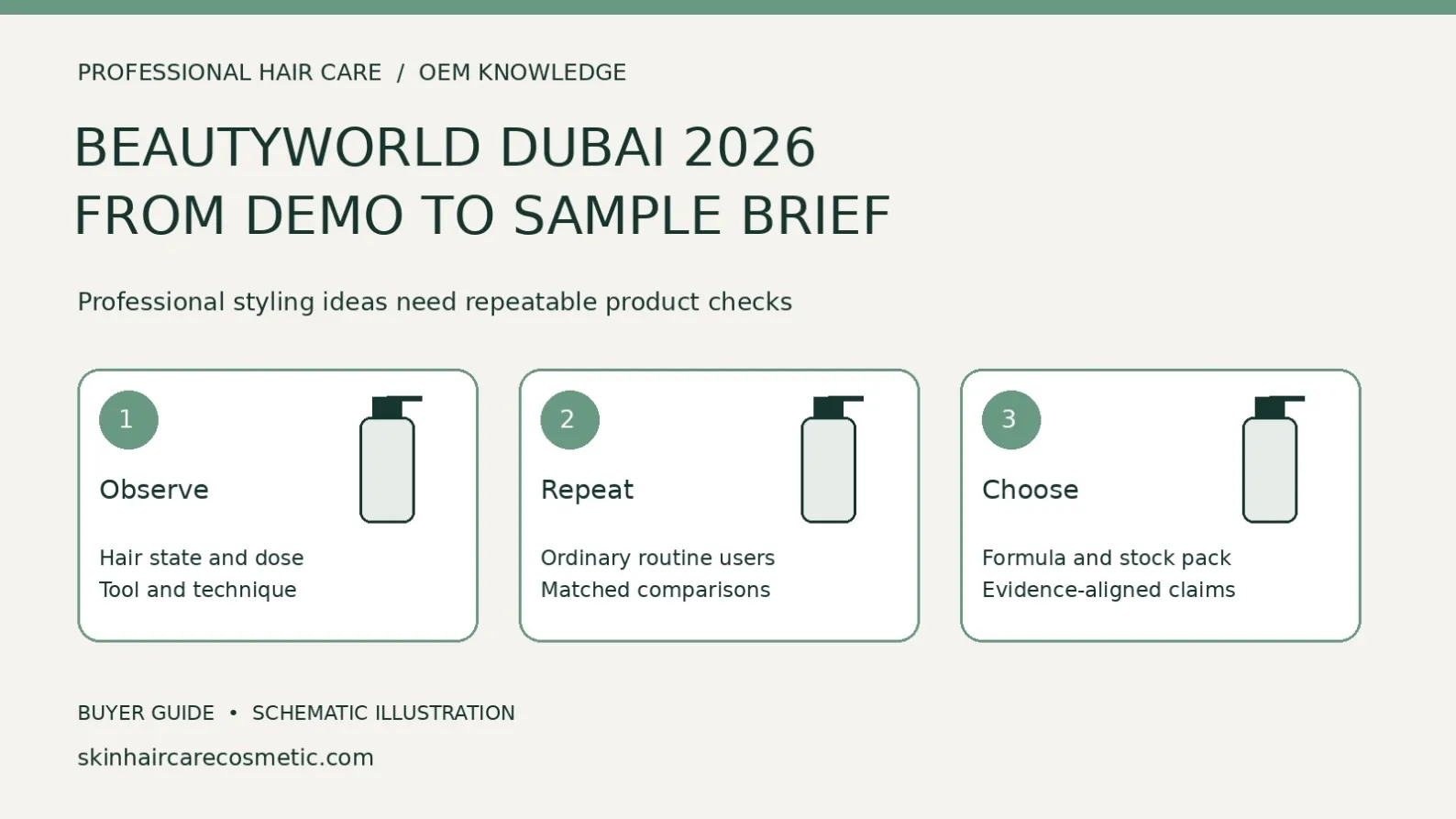
A styling demonstration can help define the desired finish, but it cannot by itself prove that a leave-in formula will deliver the same result for your customers. Record the hair state, product dose, tools and technique, then compare samples under a repeatable routine. Separate the formula's contribution from the stylist's work before choosing a private-label product or making a performance claim.
What the show programme confirms
Beautyworld Dubai's beautyLIVE agenda lists professional hair demonstrations for 7 October 2026, including Josh Lamonaca, Mounir, Shark Beauty and KERALOOK. Official programme, checked 7 October. A scheduled demonstration is not an independently verified product test or a guarantee of commercial demand.
Cosmetics Europe's May 2008 efficacy guidance, checked 7 October 2026, discusses defined protocols and different evaluation approaches. It is older methodological context, not a new finding from this week's show. The practical screen below is our proposed buyer brief rather than a certified test method.
Describe the finish before choosing ingredients
Write a plain target such as a soft, controlled finish on the intended hair group. Avoid beginning with a long ingredient request simply because those ingredients appeared in a presentation. First decide whether the leave-in is intended for detangling, a blow-dry preparation step, natural-texture styling or a refresh between washes.
A product applied to damp lengths before heat styling has a different evaluation routine from a product applied to dry hair between washes. Specify whether scalp application is intended. Product instructions, sample selection and safety review should match that use rather than leaving the brand to improvise after delivery.
Record the hidden variables in a good demonstration
| Variable | What to record | Why it matters to the comparison |
|---|---|---|
| Hair starting condition | Type, damage history and moisture state | Different starting points change the apparent finish |
| Application | Amount, sections and distribution | Dose can determine whether a finish feels heavy |
| Tools | Tool setting and passes | Technique can contribute strongly to the result |
| Other products | Shampoo, conditioner and stylers used | A full routine cannot isolate one leave-in |
| Assessment time | Immediately styled and later observation | A fresh finish is not a persistence result |
Photographs are useful records when lighting and positioning are consistent. Do not digitally enhance an outcome image and then present it as product evidence.
Repeat with a comparison and ordinary instructions
Ask the supplier for coded, suitable samples. Compare a benchmark routine with and without the proposed leave-in while keeping other steps consistent. Agree on the relevant hair group and evaluation criteria before collecting feedback. If several stylists participate, record who applied each sample so unusually skilled handling does not disappear into the average.
A simple buyer screen may reveal whether a sample spreads easily or leaves unwanted residue at a stated dose. It does not establish a numerical heat-protection claim. Such a claim needs a study suited to the tool, exposure and damage endpoint being advertised. Avoid borrowing a temperature number from another product.
Test the filled stock pack, not only a laboratory jar
Once a formula is shortlisted, evaluate it through the intended closure. Ask users to describe whether the dispensed amount is easy to control. Assess the first use, repeated dispensing and handling with wet hands. For a spray, observe coverage and overspray; for a pump, observe dose and distribution. Do not assume those pack routes are interchangeable.
Selected mature formulas with in-stock bottles may be available from 100 pieces per SKU. Confirm formula and component eligibility together. Changing to a new sprayer or customizing the formula can change the quantity, testing and timetable.
Decide what belongs on the label
Keep the primary use instruction clear and retain the approved formula version. A credible first product may need fewer claims than the original demonstration suggested. Describe sensory benefits only within the evidence collected. Do not claim permanent repair, universal hair-type suitability or an exact protection level without adequate support.
Review relevant hair-care formats as development options rather than implied duplicates of a show brand. Develop an original product brief; copying another brand's name, campaign or appearance does not improve technical fit.
For related sampling, review the textured-hair leave-in and styling formats. Shortlist a relevant format and confirm the actual formula, dosing instructions and available stock pack.
Buyer FAQ
Can a stage result establish the leave-in's efficacy?
No. The hair, tools, other products and technique may all contribute to that result.
Should I request a spray or a pump first?
Choose according to the intended formula, dose and application. Assess the filled pack before approval.
Is the screen in this article a standardized laboratory method?
No. It is a proposed procurement screen. Formal claims require suitable commissioned studies.
Can I start with a selected mature leave-in formula?
Yes, if an appropriate mature formula and stock pack are available; confirm the exact SKU and minimum quantity.
Project discussion
Send the target hair group, intended styling routine, finish, preferred pack and first-order quantity through Contact. Request samples with clear dosing instructions and a written comparison plan before selecting a small private-label run.