
Curl Refresh Mist OEM: Check Spray Coverage and Dark-Hair Residue
Assess curl refresh mist OEM samples for spray coverage, repeat-use residue and dark-hair visibility before approving the formula and stock sprayer.
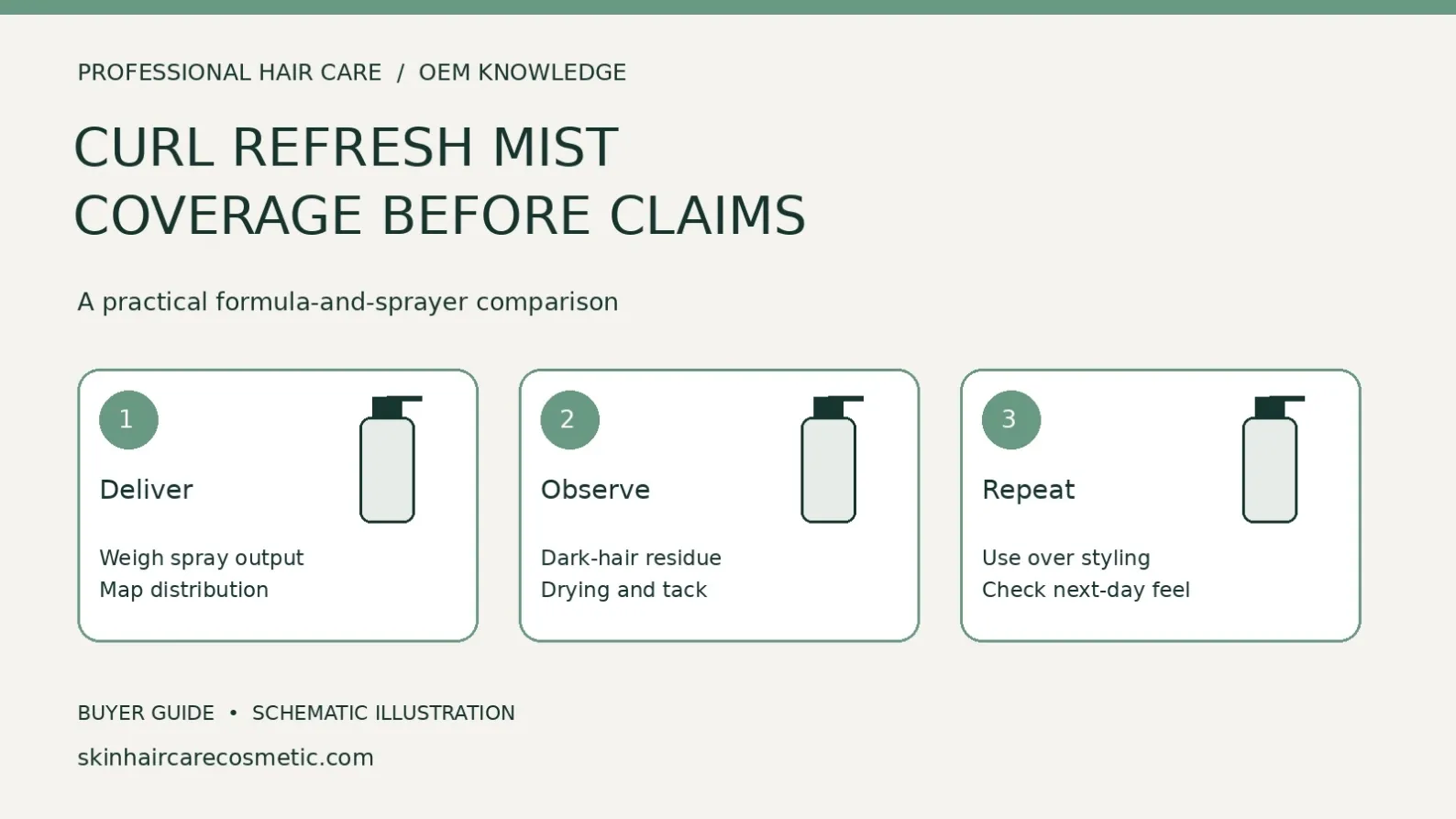
Direct answer
Approve a curl refresh mist by testing the formula with its final sprayer on representative dark and textured hair. Measure output, review coverage at the instructed distance, and evaluate residue after drying and repeated use over existing styling products. A fine-looking spray in the air does not prove even application, a non-crunchy finish or acceptable results on every curl pattern.
The evidence approach
Cosmetics Europe's efficacy guidance describes sensory, instrumental and other study approaches. Source: guidance, May 2008, accessed 6 October 2026. Our proposed procurement screen below translates that general distinction into practical questions for a curl mist; it is not a standardized protocol from the guidance.
Public creator content can help identify questions about application, but this review does not establish a new platform-wide curl-mist sales trend. Treat product demonstrations as hypotheses to test, not as a substitute for an approved formula assessment.
Start with the actual use case
Define whether the customer is refreshing loose waves, dense coils or hair carrying gel from the previous day. Establish whether the instructions involve spraying directly, applying through hands, scrunching or reshaping individual sections. A mist meant for roots has a different placement brief from one intended for lengths.
Specify acceptable finish in ordinary language: softness, movement, defined appearance and limited tack. Do not use a long ingredient list as the acceptance criterion. The combined formula, styling layer and dose determine the experience being purchased.
Screen delivery before judging performance
Output and consistency
Weigh the bottle before and after an agreed number of complete strokes. Record priming, failed strokes, drips and output variation. Repeat near the beginning and end of the pack. Retain the sprayer component code and sample formula version.
A spray card can reveal the deposition pattern at a fixed distance. It is a comparative delivery check, not proof of respirable droplet size or inhalation safety. Ask the appropriate specialist for any required spray safety assessment; avoid calling a visual pattern test a particle-size measurement.
Coverage on hair
Use matched sections and a recorded amount. Keep application distance, hair moisture and manipulation consistent. Check whether the outer surface receives most of the product while inner sections remain untreated. If a different technique fixes the issue, assess whether customers can follow that technique from concise directions.
Compare a formula at equal delivered mass as well as under intended spray instructions. Otherwise, a more powerful pump can make a weak formulation seem effective simply by applying more product.
Assess visible residue on dark hair
Use consistent lighting, a neutral background and matched camera settings. Review dried hair before and after agreed handling. Record white deposits, flakes, dullness and tack separately. Check clothing contact where relevant to normal use.
| Observation | Possible follow-up | What it cannot prove |
|---|---|---|
| Patchy wetting | Review distance and application sections | Universal curl suitability |
| White deposits after drying | Review dose and formula compatibility | The ingredient causing the issue |
| Flakes after manipulation | Compare existing styling layers | A quantified breakage benefit |
| Heavy next-day feel | Repeat with realistic dose and routine | Guaranteed long-term performance |
A failed combination may be specific to one styling product. Record what was layered beneath the mist before rejecting or approving the whole concept.
Add a realistic repeat-use review
Compare fresh application with refresh over a retained styling layer. Follow the intended wash frequency rather than repeatedly applying many doses in a single session. Include more than one relevant styling system and hair type when the brand intends broad positioning.
Predefine acceptance criteria for output consistency, visible residue and user-rated finish. The development team should agree them before seeing the results. A small usability panel can guide instructions; a numerical public claim needs a study designed for that claim.
Low-MOQ route and range fit
Selected mature formulas using in-stock bottles may begin at 100 pieces per SKU. Confirm the exact formula, sprayer and available fill size. Fragrance or conditioner changes can alter the assessment and require renewed review.
Explore professional hair-care options and the anti-frizz care system for adjacent routine roles. A refresh mist should earn a distinct place in the range rather than duplicate a heavier leave-in.
Buyer FAQ
Does a fine mist guarantee no residue?
No. Delivery, dose, drying and existing styling layers all require evaluation.
Should dark hair be included in the test?
Yes when it represents the intended users, particularly for visible deposit and flaking review.
Can one spray test support all curl types?
No. Select representative hair and use patterns for the claimed audience.
Is a spray card a safety test?
No. It is a comparative distribution check; safety assessment is a separate task.
Project discussion
Send target curl patterns, styling layers, application method, bottle size and quantity through Contact. Ask for the mature formula in the proposed stock sprayer and agree a residue-and-coverage scorecard before production.