
Hair-Care Industry Outlook After October Promotions: Which Signals Justify a Reorder?
Separate October hair-care promotion signals from repeat demand. Use sell-through, returns and customer feedback to decide whether a small brand should reorder.
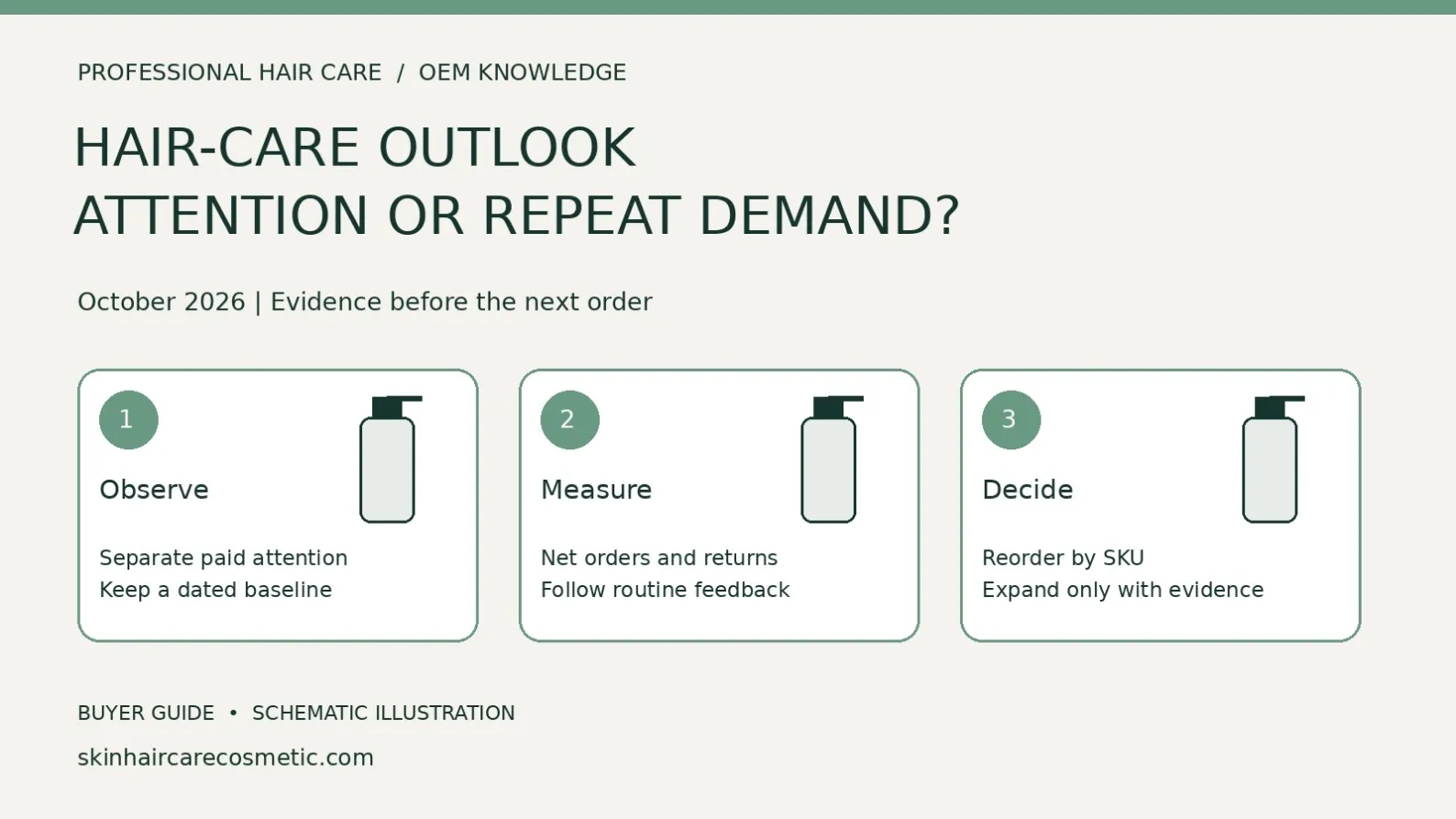
Direct answer
A small hair-care brand should reorder against its own net sell-through, stock position, returns and repeat-use feedback. Promotion coverage can identify what buyers are being shown, but it cannot establish demand for your formula. Treat a larger order as a decision with an evidence threshold, not as the automatic next step after a busy sales week.
What is confirmed on 8 October 2026?
Amazon's event page, checked on 8 October, lists its US Prime Big Deal Days window as 6–7 October 2026 in Pacific time and features hair-care offers. This is a dated retail promotion signal. It does not publish audited category sales or establish that a new private-label brand will reproduce another brand's results.
The calendar matters when comparing reports. A US promotion ending late on 7 October can overlap 8 October in Asia. Record the platform's time zone rather than treating screenshots collected on different local dates as different events.
Outlook: three scenarios instead of one growth forecast
The following are planning scenarios, not predictions supported by a market-size model. They help a small brand decide which evidence to collect next.
| Scenario | What you might observe | Sensible purchasing response |
|---|---|---|
| Promotion-led trial | Orders rise during an offer but normal-price interest remains unclear | Hold expansion; observe the first users through their routine |
| Useful hero product | One SKU receives consistent feedback and repeat orders | Replenish that SKU before adding adjacent products |
| Weak routine fit | Complaints concern residue, dose or confusing instructions | Reassess formula, pack or directions before buying more |
The unknown is durable demand: neither retailer coverage nor public social activity resolves it for your particular channel. A salon's replenishment pattern and an online brand's acquisition pattern can differ even when both sell the same product category.
Build a small evidence sheet
Use one row per SKU and a defined reporting period. Enter opening stock, units received, paid orders, cancellations, fulfilled units, returns and closing stock. Keep complimentary samples separate from sales. Record the offer price alongside the normal selling price, and keep paid-media spending visible.
Then add qualitative evidence: who used the product, how often, at what dose and with which other routine steps. A claim such as “too heavy” becomes more useful when linked to fine hair, a particular application amount and an existing styling product. Anonymous praise alone does not reveal the reason to reorder.
Define the decision before looking at the result
Set a replenishment trigger appropriate to your cash budget, expected lead time and stock risk. This may combine a minimum remaining stock level with acceptable returns and repeated positive use feedback. There is no universal percentage that guarantees success. Agree the trigger with your own sales and operations team and document exceptions.
Avoid using a promotion's highest daily order rate as the sole production forecast. Calculate a base case from a representative period and a separate upside case. If the two cases require very different inventories, ask whether a smaller replenishment or staged delivery can reduce exposure.
What this means for a 100-piece route
Selected mature formulas using available stock bottles may support orders from 100 pieces per SKU, subject to project confirmation. That quantity is a supply option, not a representative consumer study. A brand can use it to test its channel, instructions and pack economics without committing to a complete range.
Do not divide a small budget across too many nearly identical products. If a mask and conditioner compete for the same routine role, establish the buyer's reason to choose each before replenishing both. Custom fragrances, formulas, containers or decoration can change minimum quantities and development costs.
Buyer FAQ
Does a discounted bestseller prove my private-label concept will sell?
No. It shows activity around another offer. Your price, formula, customer base and distribution need their own evidence.
Is 100 pieces enough to forecast annual demand?
No. A small launch may reveal practical problems and early channel interest, but annual forecasts need broader evidence and explicit assumptions.
Should a brand reorder every SKU in a set together?
Only when stock and demand justify it. Review each SKU's role, sales and remaining inventory independently.
What remains uncertain in this outlook?
Category-level sell-through, comparable normal-price demand and your customers' repeat-purchase behavior are not established by the public promotion page.
Project discussion
Review the product catalogue and the textured-hair collection as possible routine structures, not a requirement to order an entire set. Send your target country, buyer channel, current SKU results, desired quantity and stock-bottle preference through Contact. Ask which mature-formula routes are available before budgeting a reorder.