
Hair-Care Industry Outlook: What Fewer, Better Products Could Mean for Small Brands
Assess the October hair-care outlook through simpler routines, verifiable product value and small-batch evidence before expanding a private-label range.
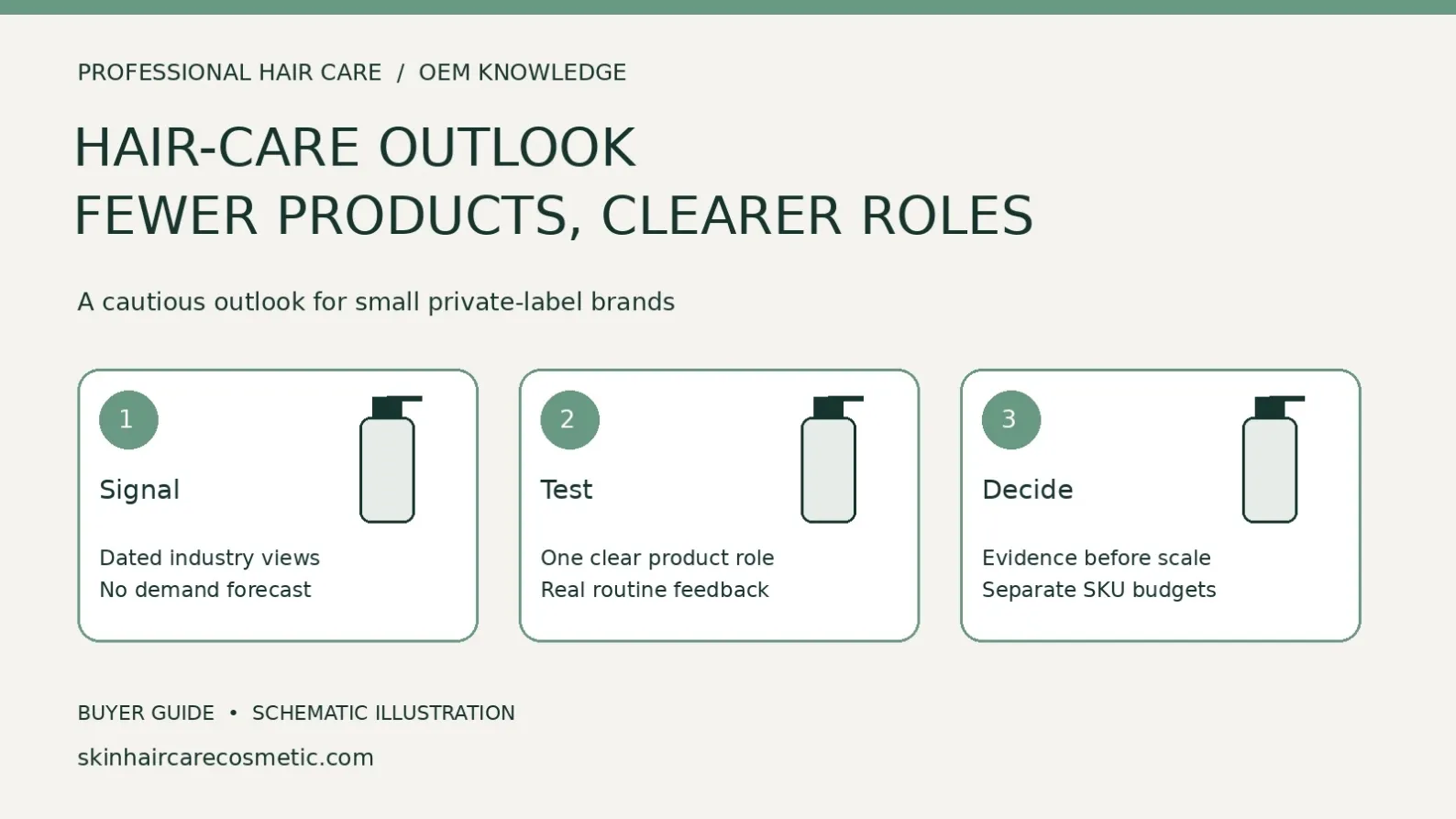
Direct answer
A smaller hair-care range is worth testing when each product has a distinct, useful role and buyers can verify its performance in their routine. Current signals support asking that question, but they do not prove that fewer SKUs will sell better. Start with a defined customer, a mature formula and a measurable pilot before treating simplification as a purchasing strategy.
What has actually happened
Beautyworld Dubai published an editorial on 7 October 2026 discussing simpler routines and greater value from individual products. Organizer article, checked 7 October. This is a qualitative industry interpretation, not a consumer survey we have independently validated.
Amazon lists Prime Big Deal Days for 6–7 October 2026. Retailer overview, checked 7 October. The event's timing is verifiable; completed hair-care sales and subsequent reorder demand are not established by that page.
Our outlook: a focused range may make product education and initial inventory easier for a small brand. That is a business hypothesis. Whether it improves repeat purchase depends on product experience, effective price, channel and supply. Neither a show conversation nor a discounted order demonstrates a durable change in demand.
Separate a useful hero product from a crowded claim list
A leave-in could have a clear primary role such as helping consumers manage the feel of dry lengths. A shampoo could be positioned around its intended cleansing experience. Decide which job matters most before adding secondary claims. Several attractive words on a label do not show that one formula can replace several steps.
Write the user's current routine in order. Identify the step the proposed SKU replaces, the step it still needs and the likely dose. If a buyer still needs the same conditioner and styling gel, explain the leave-in's added value rather than describing the whole routine as simplified.
Compare the routes on the same basis
| Range route | Question to answer | Evidence needed before expansion |
|---|---|---|
| One hero SKU | Does it solve the priority routine problem? | Sample feedback at the intended dose |
| Two complementary SKUs | Does the second add enough value? | Comparison with and without the second step |
| A larger collection | Are the roles distinct and commercially viable? | Separate feedback and cost assumptions per SKU |
Treat this table as a planning tool, not a recommendation that every brand use the same number of products. A salon's service routine and a consumer's home routine can need different formats and instructions.
What a selected 100-piece route can reveal
Selected mature formulas with in-stock bottles may start from 100 pieces per SKU, subject to confirmation. That route lets an eligible brand review product instructions, packaging practicality and initial customer feedback without requesting extensive formula development first.
It does not turn 100 shipped units into a statistically representative efficacy study. Some units may be samples, replacements or staff use. Keep their disposition visible. Ask whether buyers understood the role, how they dosed it and what they combined it with. Separate texture dislike, fragrance preference and actual packaging faults so the next decision addresses the right problem.
A professional format, new formula or special component needs its own quotation. Do not assume the small-order route covers every concept raised at an exhibition.
Three scenarios to monitor
Focused adoption: users understand the product and repeatedly use it in the intended routine. Consider a reorder only after checking inventory, contribution and available components.
Appealing concept, weak experience: people like the story but abandon the formula or use it incorrectly. Improve the brief or instructions before extending the range.
Attention without purchase: inquiries rise while paid demand remains unclear. Keep sampling and product education proportionate to what is known. Do not manufacture a full collection merely to match a social conversation.
Set a review date around actual use opportunities. A quick rinse-off product and a once-weekly treatment generate useful feedback at different speeds. No fixed seven-day window proves repeat demand for every category.
For related sampling, review the curl-cream development option. For a defined styling role, compare this option with the intended routine before selecting a mature formula.
Buyer FAQ
Does this outlook prove that multifunctional hair care is growing?
No. It identifies a dated editorial signal and a testable product-planning hypothesis, not verified category growth.
Should a small brand launch only one product?
Not automatically. Choose the smallest range that meets the target customer's actual routine needs.
Does a 100-piece order support clinical claims?
No. Commercial pilot feedback and appropriately designed efficacy studies serve different purposes.
Can every formula be ordered from 100 pieces?
No. That option is limited to selected mature formulas and in-stock bottles, with SKU-level confirmation.
Project discussion
Review available product routes and send the target customer, routine, country, intended pack and per-SKU quantity through Contact. Ask which mature formulas qualify for a focused trial, then agree what feedback will justify the next order.