
Hair-Care Industry Outlook: Is a Smaller Launch Range the Better Bet After October Events?
Assess a smaller hair-care launch using October 2026 signals, clear SKU roles and pilot economics. Separate industry commentary from verified customer demand.
Direct answer
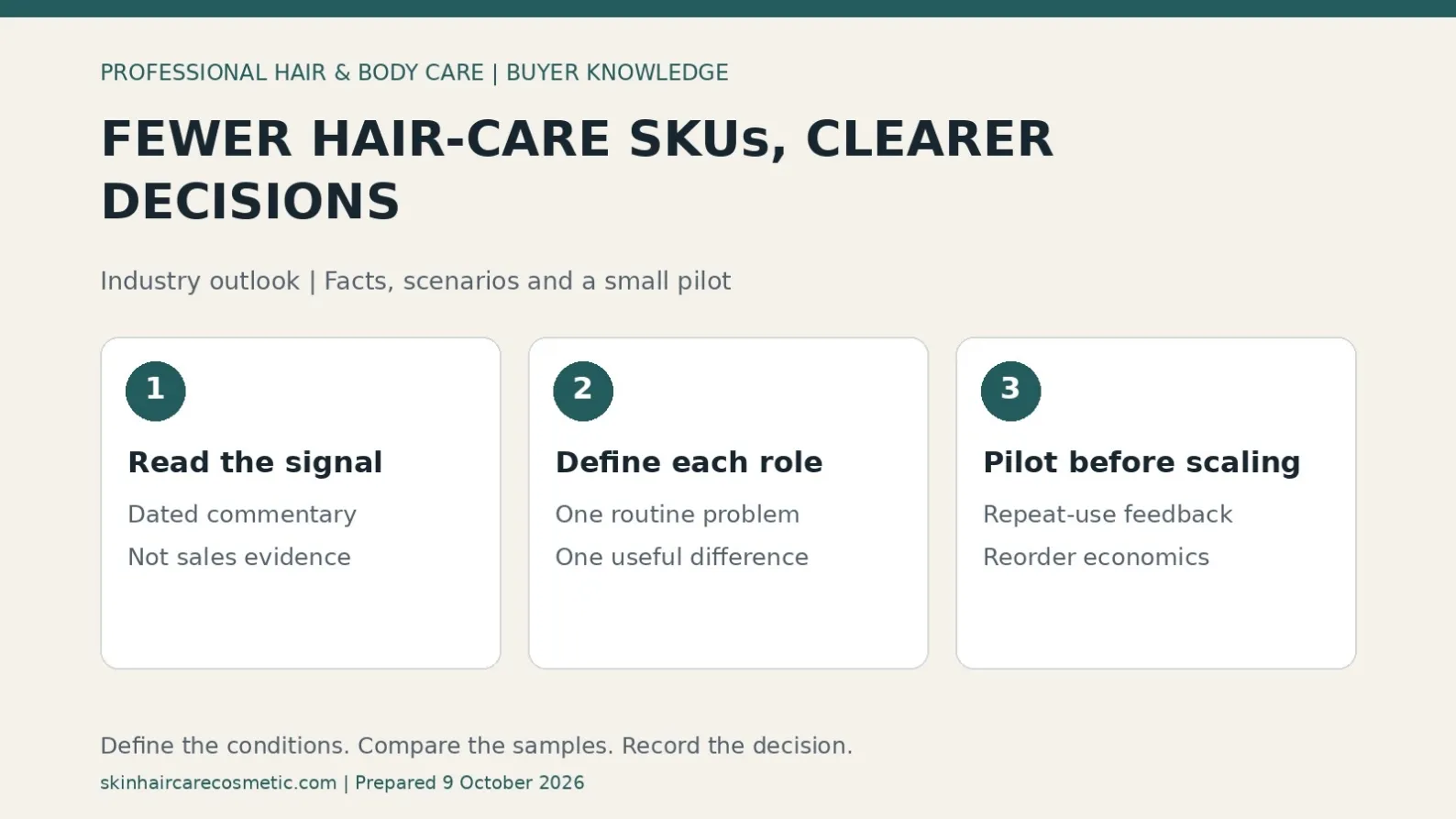
A smaller range is a sensible pilot when each SKU has a distinct job and the brand can measure repeat use, margin and reorder demand. October commentary supports investigating simpler routines; it does not prove that every market wants fewer products. Start with a focused mature-formula shortlist and expand only when a missing role is demonstrated.
What changed this week, and what remains unproved
On 7 October 2026, the Beautyworld organizer’s insight discussed simpler routines and multifunctional beauty. This is published industry commentary, not a quantified hair-care demand study.
The organizer homepage, accessed on 9 October, states that the 2026 Dubai edition has closed. Amazon’s official promotion page places the US event on 6–7 October, Pacific time. Neither source establishes your brand’s repeat-purchase rate.
These signals create a useful planning question: can a buyer explain each product’s contribution to a routine? They do not answer which shampoo texture or leave-in dose will work for a specific customer group. That decision still needs product and channel evidence.
Give every proposed SKU a different reason to exist
Write a one-sentence job for each item before naming the collection. A cleanser may address the wash stage; a conditioner may support detangling; a finishing product may address a dry-hair appearance need. If two products have the same application zone, frequency and outcome, explain their practical difference or postpone one.
A three-item set is not automatically superior to a two-item set. Nor is a multifunctional product automatically sufficient. A customer who needs a richer rinse-off treatment may still value a separate product. Keep the comparison tied to routines rather than counting claimed benefits.
Use a role matrix before a purchase order
| Decision | Evidence to collect | Reason to delay |
|---|---|---|
| Core wash step | Customer routine and sample wash feedback | The proposed cleanser has no clear user group |
| Conditioning step | Controlled dose and rinse observations | Two items solve the same task without a useful difference |
| Optional finishing step | Application and repeat-use feedback | Interest exists only in a short promotional clip |
Treat a small MOQ as a learning route
The small-site offer, checked on 9 October 2026, limits the 100-piece starting route to selected stable formulas and in-stock bottles. Formula changes, fragrances, decoration and special components are quoted separately.
Do not split a modest budget into many weakly supported variants simply because the initial unit quantity is manageable. Request the eligible formula and bottle combination in writing. Reserve money for sample review, destination documentation, freight and a second round of feedback. Low quantity reduces inventory exposure; it does not remove release requirements.
Three possible outcomes to watch
Base-case judgment: focused ranges may make retailer training and consumer directions easier when the products have distinct roles. Upside scenario: a successful hero product generates repeated requests for a complementary step. Downside scenario: reduced assortment leaves an important hair type or routine underserved. These are planning scenarios, not forecasts with measured probabilities.
Track paid orders separately from enquiries, and repeat purchases separately from promotion-driven first orders. Ask customers what they actually finished, what they stopped using and what they would replace. Record returns and confusing instructions alongside positive comments. A future expansion should answer a repeated unmet need rather than imitate every exhibition launch.
A practical decision at the end of the pilot
Continue a SKU when its role is understood, samples meet the agreed expectations and the commercial model leaves room for support and reorder costs. Revise instructions if a usable formula is being over-applied. Pause a duplicate item if customers cannot explain why they need it. Do not attribute success or failure to an industry headline when dose, channel or packaging changed at the same time.
Buyer FAQ
Does the simpler-routine signal prove that fewer hair products will sell better?
No. It supports a testable planning hypothesis. Your channel, customer routines, product performance and repeat orders determine whether a smaller range works.
Can every formula start at 100 pieces?
No. The starting route applies to selected stable formulas in stock bottles. Confirm eligibility and every customization requirement before budgeting.
Should a small brand launch a complete salon system immediately?
Only when each step has a clear role and the buyer can fund sampling, technical review and stock. A focused pilot can reveal missing steps.
What should trigger adding another SKU?
Repeated evidence of an unmet routine need, acceptable sample results and a viable reorder model. A viral clip or exhibition appearance alone is insufficient.
Related product routes and project contact
Use the product catalogue to build a shortlist around a specific routine, rather than treating every available formula as a launch requirement.
Contact the Junchun OEM/ODM team: Share your target country, channel, routine problem, proposed SKU count and budget to check eligible stock-formula routes.