
Hair-Care Outlook After October Deals: Separate Discount Demand from Reorders
Read the October hair-care outlook through promotion-adjusted demand, return reasons and repeat use before increasing a small OEM order.
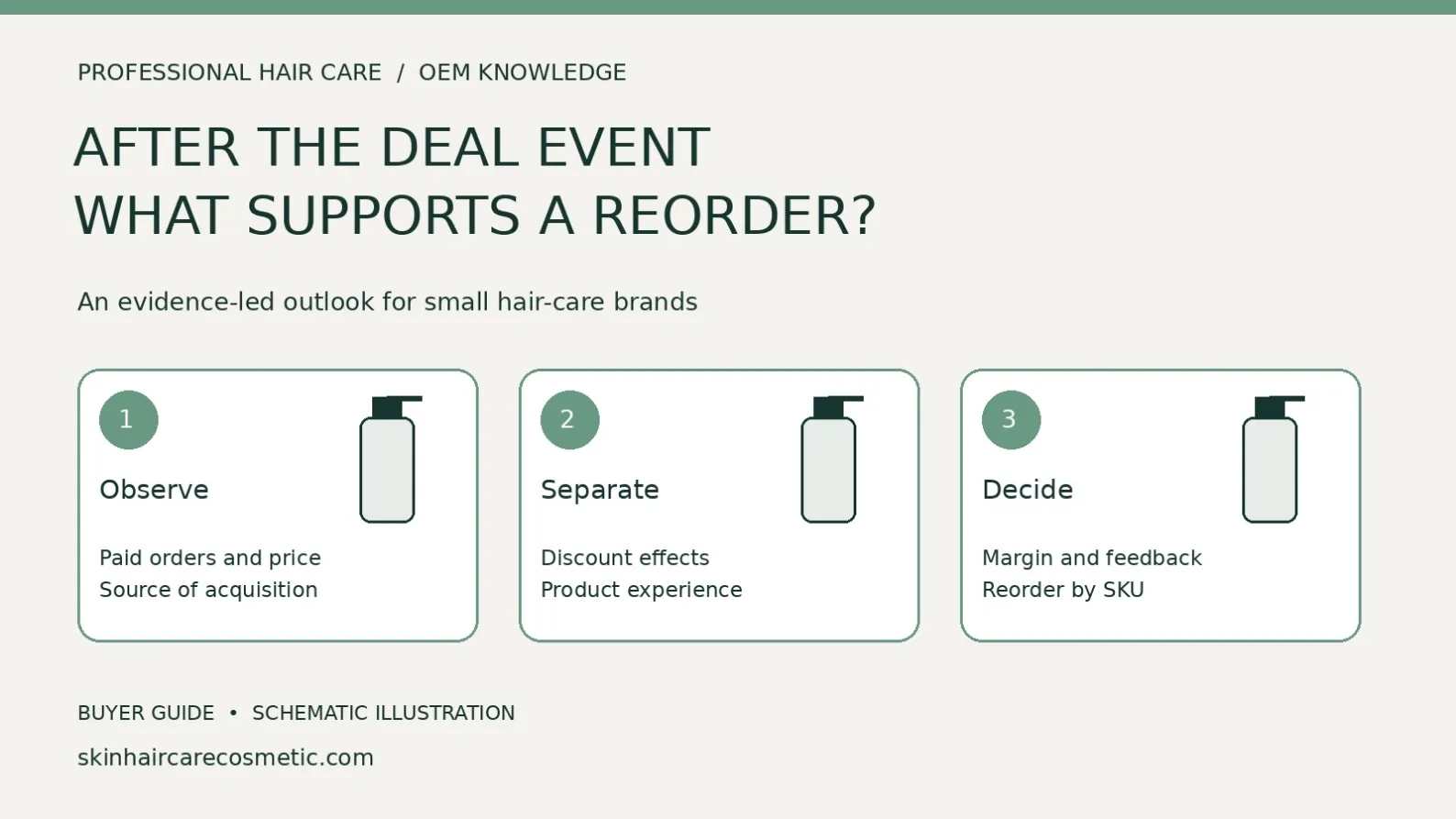
Direct answer
A short sales increase during an October deal event is a reason to investigate demand, not an automatic reason to enlarge a hair-care order. Small brands should separate discounted acquisition from product satisfaction, measure contribution after returns, and wait for a realistic repeat-use opportunity. A selected mature formula in a stock bottle can support a limited pilot, but its reorder should follow evidence about the product and channel.
What is verified on 6 October 2026?
Amazon lists its Prime Big Deal Days for 6–7 October 2026, including beauty. This is a scheduled promotional window, not published evidence of hair-care sell-through. Source: Amazon event overview, accessed 6 October 2026. At the time of this review, final event results are unavailable.
A separate channel signal is e.l.f.'s new body-care launch, with announced TikTok Shop access and Amazon availability. Source: e.l.f. release, 5 October 2026. This supports watching cross-channel launches; it does not establish growth for a small hair-care brand.
Our outlook: more useful tests, fewer inventory assumptions
Buyer inference: competitive deal periods may encourage shoppers to try unfamiliar products. They can also attract customers primarily interested in price. A brand needs to learn which response it is observing before increasing manufacturing exposure.
The uncertain variables include customer acquisition cost, cancellations, dissatisfaction, full-price willingness and the interval before another purchase. A useful forecast therefore includes several scenarios rather than a single optimistic sales target. There is no verified Google Trends series or platform-wide hair-care growth rate in this review.
Define the cohort before interpreting the result
Keep customers acquired during the promotion separate from earlier customers and later full-price buyers. Record the effective selling price and acquisition source. If one shopper buys three bottles during a discount, do not count that as three independent indications of repeat demand.
Define a repeat opportunity around actual pack size and typical use. A customer cannot reasonably reorder a large shampoo immediately after delivery. A lack of early repurchase is not proof of product failure; equally, an early bulk purchase does not prove a sustainable routine.
A practical post-event review
| Question | Evidence to collect | Procurement implication |
|---|---|---|
| Did orders become delivered purchases? | Paid orders, cancellations and delivery outcomes | Avoid reordering against gross orders alone |
| Did the product fit the buyer? | Hair type, usage and specific feedback | Revisit target user before expanding |
| Was the margin viable? | Net receipts and variable costs | Retain a reorder only if the economics work |
| Did customers finish and return? | Repeat behavior after a use opportunity | Distinguish trial from continuing demand |
Use a shared review date for the commercial team and supplier. Include the formula version, bottle component and label instructions. Feedback on the wrong dose or a different sample should not be used to approve production unchanged.
Start small without losing learning value
Selected mature formulas with in-stock bottles may begin at 100 pieces per SKU. This does not mean every custom fragrance, component or formula qualifies. Confirm the actual route before promising customers a release date.
Choose a small number of clear roles: a cleanser, a conditioner or treatment, and an optional leave-in. A pilot with too many similar products makes it difficult to know what drove satisfaction. Review professional hair-care options and choose the range around a specific user rather than a long list of fashionable ingredients.
Decide whether to retain, revise or pause
Retain a SKU when product experience, commercial contribution and feasible supply align. Revise when feedback identifies a tractable issue such as confusing instructions or unsuitable dispensing. Pause expansion when the evidence is too thin or complaints require investigation. Agree who makes the decision and what information remains outstanding.
Buyer FAQ
Does a strong deal-day result prove a lasting trend?
No. It reflects a specific offer and audience; persistence needs evidence after the promotion.
Should a small brand reorder immediately after selling out?
First check paid demand, margin, complaints and realistic delivery commitments. A sell-out may also reflect very limited opening inventory.
Does 100 pieces include a custom bottle?
The small-order route applies to selected mature formulas with in-stock bottles. Custom components require separate review.
Is a slow repeat purchase rate always negative?
No. Interpret it against pack size, dose, delivery date and expected consumption.
Project discussion
Send the target market, sales channel, chosen product roles, pack sizes and pilot quantity through Contact. Request a formula-and-stock-pack proposal with explicit reorder assumptions; keep the final commercial decision tied to your own customer evidence.