
Hair Gloss Serum OEM: Check Pump Recovery After the Bottle Has Been Resting
Check hair gloss serum pump recovery after rest, near-empty dispensing and realistic dose control. Evaluate the filled stock pack before a small private-label order.
Direct answer
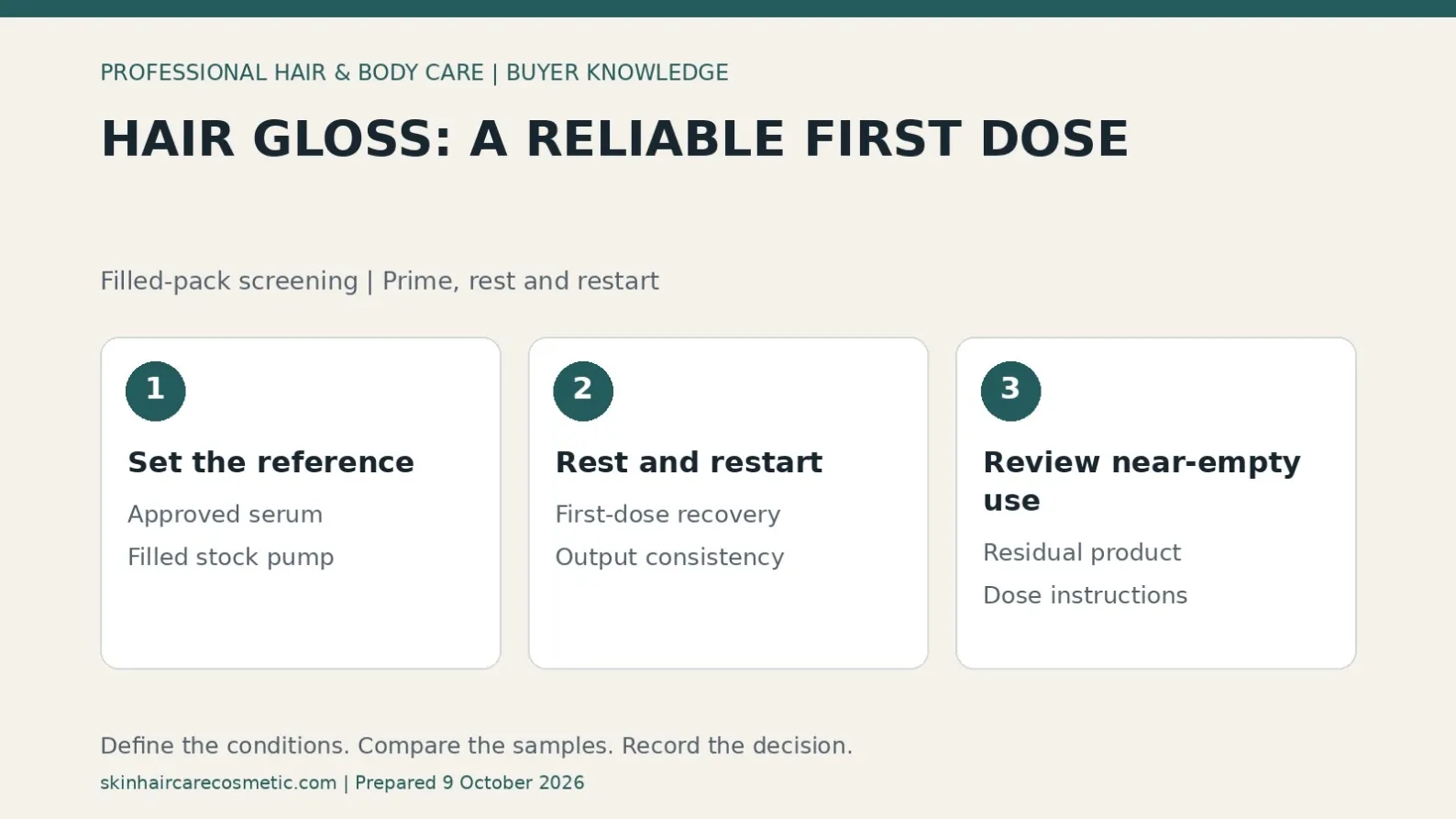
Test the proposed serum in its final pump after priming, after a documented rest interval and near the end of the pack. Record first-dose recovery, output variation, leakage and residual product. Evaluate the amount on the target hair type before writing directions. A pump that looks premium is not automatically a suitable dosing system.
The opportunity is a visible finish, not an unlimited dose
The current hair gloss product page, accessed on 9 October 2026, offers a finishing-serum OEM route. This confirms an available product direction, not a new launch or measured sales trend.
Shine-focused content can make a finishing product easy to explain, but a buyer still needs to know how much the pack delivers. An intermittent large first dose can overload the intended application. A consistently tiny dose may require excessive pumping. Define the expected user action before choosing a bottle.
Keep formula and dispensing components together
Request the sample’s formula code, fill amount, pump reference, dip-tube length and closure details. Do not assess a laboratory jar and then assume a decorative pump will perform similarly. Ask the supplier how the proposed component was selected and whether it has been evaluated with that exact formula.
Use more than one filled unit when screening consistency. Record the conditioning and storage conditions and avoid treating a single successful press as approval. If the formula or component changes, ask what needs to be reassessed. This buyer screen complements supplier validation; it does not replace it.
Document three stages of use
| Stage | Record | Question to resolve |
|---|---|---|
| Initial priming | Number of actuations before delivery | Can the directions explain the startup? |
| Restart after rest | First outputs, sputtering or delay | Does the customer obtain a predictable dose? |
| Near-empty pack | Output and residual content | Can the remaining product be dispensed normally? |
Make the rest interval realistic and explicit
Choose intervals that reflect intended use and agree them with the technical team. A daily finishing serum and an occasional salon add-on can have different restart requirements. Record orientation and any transport handling. Do not assign a universal pass limit without reference to the pack design and product brief.
Where equipment is suitable, compare container mass before and after a defined sequence of actuations. Identify first-dose behavior separately from later steady dispensing. Do not convert mass to volume without suitable density information. A pump count alone can hide variable delivery between units.
Relate pack output to hair application
Apply the intended dose to the defined lengths or ends and compare it on the selected hair group. Keep the application zone and drying state fixed. Note distribution, greasy feel and whether the user can reduce the dose reliably. A dispenser that cannot deliver a practical small amount may be unsuitable for the chosen positioning.
Avoid correcting an oversized output with vague instructions such as “use a little.” If the recommendation is half a pump, establish whether ordinary users can repeat that action. A different actuator or a different product role may be more honest than a complicated instruction.
Review failure before placing the small order
Separate a startup problem from blockage, air intake, leakage or formula incompatibility. Send the supplier photographs, component identifiers and the sequence that produced the observation. Retain affected units when appropriate. Do not clean or modify the internals before the supplier can investigate the original issue.
A stable formula with a compatible stock pack may qualify for the selected 100-piece route. Confirm the exact combination and commercial scope. Approve the final filled sample, operating directions and expected delivery behavior together. Package recovery is a procurement condition, not evidence of repair efficacy or humidity resistance.
Buyer FAQ
Why test after the pump has been resting?
The first dose after an interval may differ from steady repeated dispensing. Document the interval and conditions that match the intended routine.
Is counting pumps enough to compare output?
Not always. Suitable mass measurements can show output variation. Record priming and first doses separately from later actuations.
Can pump performance support a hair repair claim?
No. It supports dispensing suitability. Finished-product efficacy claims need appropriate evidence for the exact formula and use conditions.
Can the bottle be changed after testing?
A new component may affect delivery, leakage or compatibility. Document the change and agree the checks required before approval.
Related product routes and project contact
Use the hair gloss route to discuss a filled stock-pack sample, rather than selecting the pump from a photograph alone.
Contact the Junchun OEM/ODM team: Send the serum role, hair group, size, intended dose, usage frequency and order quantity for a suitable sample configuration.