
Leave-In Hair Spray Samples: Test Layering Over Yesterday’s Styling Products
Screen leave-in hair spray samples over a defined styling routine. Compare water-only refresh, product layering and repeat application before a small OEM order.
Direct answer
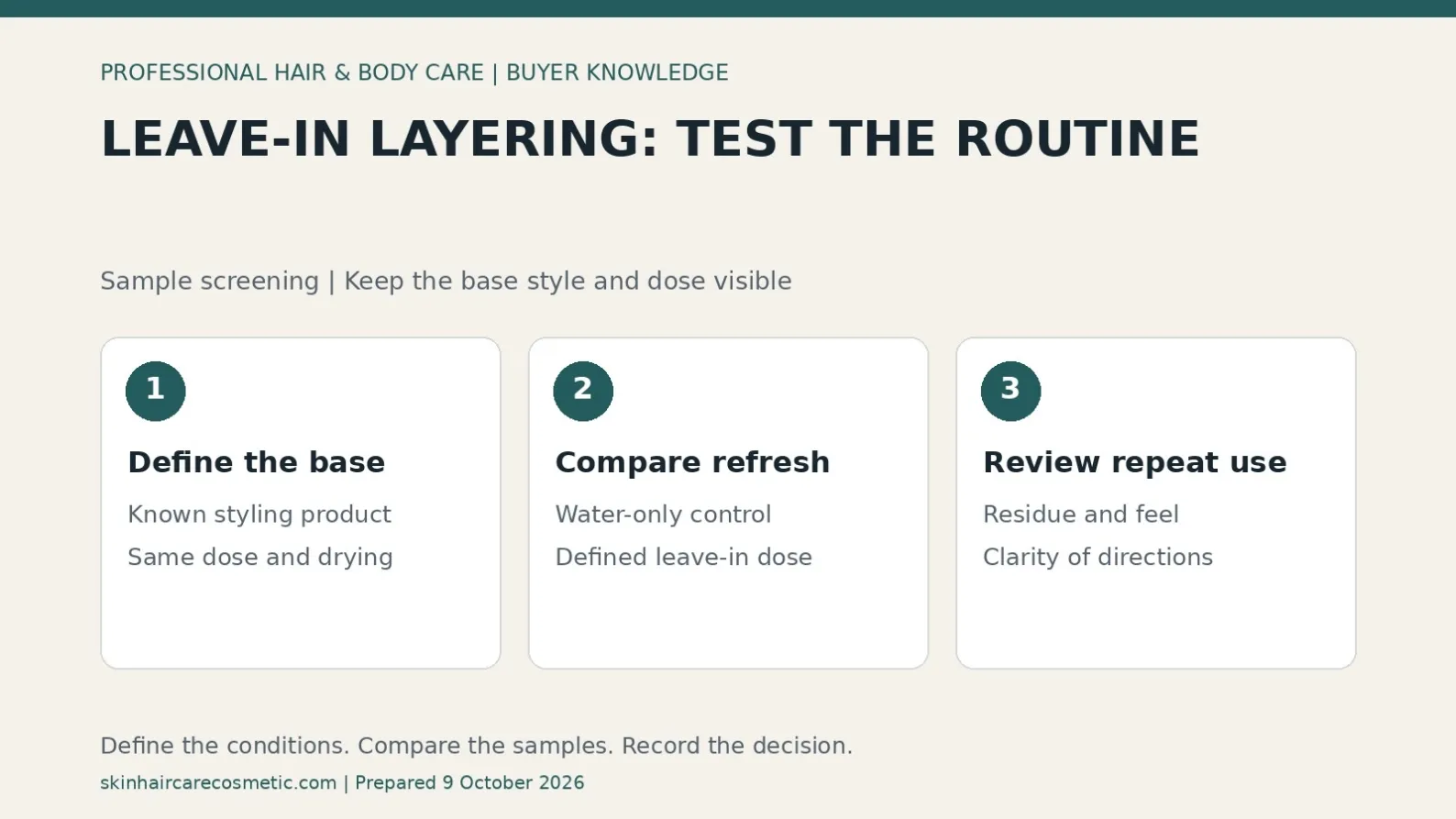
Evaluate the leave-in over a known styling product, alongside a water-only refresh and the same routine without refresh. Keep dose, application zone and drying conditions consistent. Record visible residue, tack, manageability and style disruption separately. This screening reveals routine compatibility; it does not substantiate every detangling, repair or heat-protection claim.
Why a one-step sample can miss the real complaint
The organizer’s 7 October 2026 commentary identifies interest in simpler, multifunctional routines. That supports examining product interactions, but it does not establish compatibility between any two specific formulas.
A leave-in can feel pleasant on freshly washed hair yet perform differently over yesterday’s gel, cream or finishing oil. A buyer should ask what the intended customer already uses. Without that information, a residue complaint might be attributed to the new spray even when the problem occurs only in one layered routine.
Define the product and the base routine
Record the proposed leave-in formula code, dispensing component, directions and intended hair group. Choose a relevant base styling product and record its name, version, dose and drying method. Start with a limited, explicit routine rather than attempting to represent every gel and cream on the market.
Use matched hair sections or suitable test material and document their previous treatment. If people participate, arrange an appropriate supervised use assessment for the intended cosmetic product and obtain relevant consent. This practical buyer screen is not a standardized efficacy study or a safety clearance.
Separate three comparisons
| Comparison | What to hold constant | What it helps interpret |
|---|---|---|
| Base style with no refresh | Base product, hair and drying | Change caused by time alone |
| Base style with water refresh | Application area and water amount | Effect of rewetting |
| Base style with leave-in refresh | Defined dose and application technique | Effect of the complete refresh routine |
Measure the dose rather than counting an arbitrary spray
A spray count is useful only when the actuator delivers a consistent amount. Where practical, weigh the container before and after a defined number of actuations and note priming. Use the final proposed dispenser. Record distance and whether the product is sprayed onto hair or hands before application.
Do not change the base product dose, combing method and leave-in dose simultaneously. If a sample leaves flakes, first repeat the same routine to confirm the observation. Then investigate one variable at a time. A lower dose may reduce residue while also reducing the intended conditioning effect.
Look beyond the immediate photograph
Assess feel and appearance after drying, and after the intended interval before the next wash. Note tack, stiffness, visible particles, root weight and the effort required to restyle. Describe the observation without inventing a percentage improvement. Comparable photographs need consistent light, angle and handling.
Include a repeated-use sequence that reflects proposed directions. Stop and review unexpected irritation or other adverse observations rather than continuing for a better image. Persistent buildup should trigger a discussion about formula, dose or use frequency; it should not be hidden by adding an unmentioned clarifying step.
Turn the result into a narrower buying brief
A successful sample may justify a specific claim about the assessed routine and user conditions, subject to suitable substantiation. It does not justify “works with every styling product.” A failed pairing does not necessarily disqualify the formula from all uses. Document the compatible and incompatible conditions for the technical team.
For the selected stable-formula and stock-bottle route, confirm that the evaluated configuration is the one being ordered. Custom changes require separate review. A small brand can use the screen to write clearer instructions, select one credible product role and identify whether a richer or lighter sample should be compared next.
Buyer FAQ
Is spray layering the same as a heat-protection test?
No. Layering screens routine compatibility and sensory behavior. A heat-protection claim requires an appropriate assessment of the exact finished formula.
Why include a water-only refresh?
It helps distinguish the effect of rewetting from the effect of the added formula. Keep the application conditions documented.
Can one compatible gel support a universal compatibility claim?
No. It supports an observation for that pairing and method. Broader wording requires a broader, appropriate evidence base.
Does a 100-piece order permit a new custom leave-in formula?
The starting offer applies to selected stable formulas in stock bottles. New development and changes must be scoped and quoted separately.
Related product routes and project contact
Review a mature leave-in option as a starting point, then specify the styling routine against which the filled sample will be assessed.
Contact the Junchun OEM/ODM team: Share your target hair type, existing styling products, refresh frequency, fragrance preference and planned quantity.