
Lightweight Hair Serum OEM: A Reapplication Test for Mature Formulas
Test mature hair serum formulas for repeat application, residue, movement and washout before choosing a stock bottle and low-MOQ launch route.
Direct answer
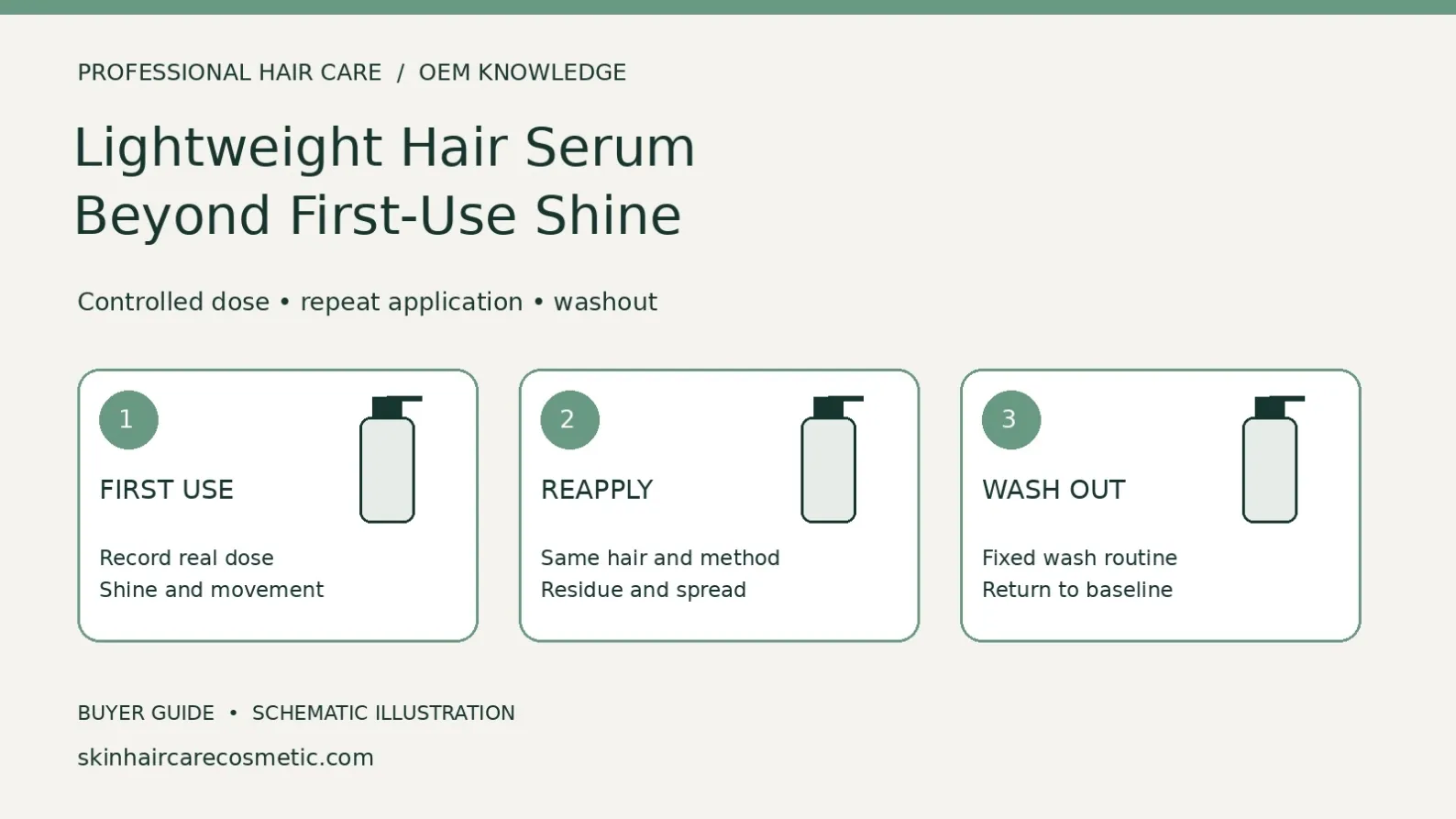
Select a lightweight hair serum by comparing the first application, later reapplication and washout on the intended hair type. Keep dose, hair condition and styling routine consistent. A sample that produces attractive shine once may feel too coated when reapplied. For low-MOQ procurement, compare available mature formulas before asking for ingredient or fragrance changes.
Why first-use approval is incomplete
Nutrafol's 30 September 2026 strand-serum announcement described a finished-product development program and disclosed use conditions for its claims. The announcement is evidence of product positioning and the brand's reported testing, not proof for another formula. Source: Nutrafol launch release, 30 September 2026.
Our procurement inference is narrower: everyday strand products should be assessed in the routine buyers intend to recommend. Testing one application cannot answer every question about next-day use.
Define the intended application first
Decide whether the serum is used on damp hair before styling, dry hair for finishing, or both. Identify lengths and ends as the application area if that is the approved use. A strand serum should not acquire scalp-use directions merely because its ingredient list looks attractive.
Specify the target hair segment. Fine untreated hair, dense curls and heavily processed lengths can produce different approval decisions. Test relevant users rather than describing an untested product as weightless for everyone.
Dose by mass before relying on pump strokes
Weigh several pump outputs to establish the approximate delivered amount and its variability. A pump stroke is useful consumer language only when the selected pack behaves predictably.
For internal sample comparison, use a measured mass and a consistent hair amount. Record the consumer-friendly dose separately. Do not confuse a precision laboratory application with normal user behavior.
A suggested three-stage evaluation
| Stage | Observation | Buyer decision |
|---|---|---|
| First application | Spread, shine, comb glide and movement | Does the product deliver its primary cosmetic role? |
| Reapplication | Distribution, tack, coated feel and loss of body | Is the dose or use frequency practical? |
| Washout | Residual feel under the agreed wash routine | Does the routine need clarification or a different base? |
This is an internal selection framework. It does not establish clinical efficacy, a standardized buildup claim or a numerical breakage result.
Use coded samples and a written rating scale. Include a “not acceptable” description for each observation. For example, a shine score should not outweigh persistent stickiness if non-sticky use is a core requirement.
Keep repeat-use results interpretable
Use the same cleanser, conditioner, drying process and reapplication interval. Log any unplanned use of dry shampoo, styling gel or hair oil. Those products can change the observed finish.
Assess both ends and the overall hairstyle. A formula may smooth dry tips while reducing movement elsewhere. If that happens, test adjusted application placement and dose before requesting a complete reformulation.
Do not compensate for an unsuitable base by adding an increasingly long instruction list. If target users regularly overapply despite clear directions, the pack output or formula may need reconsideration.
Approve the stock bottle with the formula
Check priming, output, leakage, bottle handling and formula drying around the closure. Compare the actual production component rather than an experimental bottle used for the free sample.
Review label wording with the selected use conditions. Terms such as shine, smoother feel and easier management should match evidence. Heat protection, fixed-duration frizz control, split-end reduction and quantified strength need separate support.
Small-batch development limits
Selected mature formulas using in-stock bottles may start from 100 pieces per SKU. Replacing the oil phase, removing a functional ingredient, adding fragrance or changing viscosity may move the project into a different development route.
The fruity hair-care collection can be reviewed for finishing-product roles. Confirm the exact sample code, formula and component availability rather than assuming every concept has the same stock status.
Buyer FAQ
Is shine enough to approve a serum?
No. Check distribution, residue, movement, reapplication and the intended wash routine.
Can I use one serum on both scalp and lengths?
Only if its approved formula, safety review and directions cover both uses.
Is a silicone-free formula automatically lighter?
No. Compare the finished formulas at realistic doses instead of relying on an exclusion label.
Can a 100-piece order include formula changes?
Changes are reviewed separately. The advertised small route applies to selected mature formulas and stock bottles.
Project discussion
Share your target hair type, application frequency, reference finish, size and quantity through Contact. Request two relevant mature-formula samples and their compatible stock-pack options.