
Lightweight Leave-In Milk: Find a Useful Dose Before Approving a Small Hair-Care Order
Screen lightweight leave-in milk at supplier-approved doses. Compare distribution, wet handling and dry finish before choosing an existing-formula pilot.
Direct answer
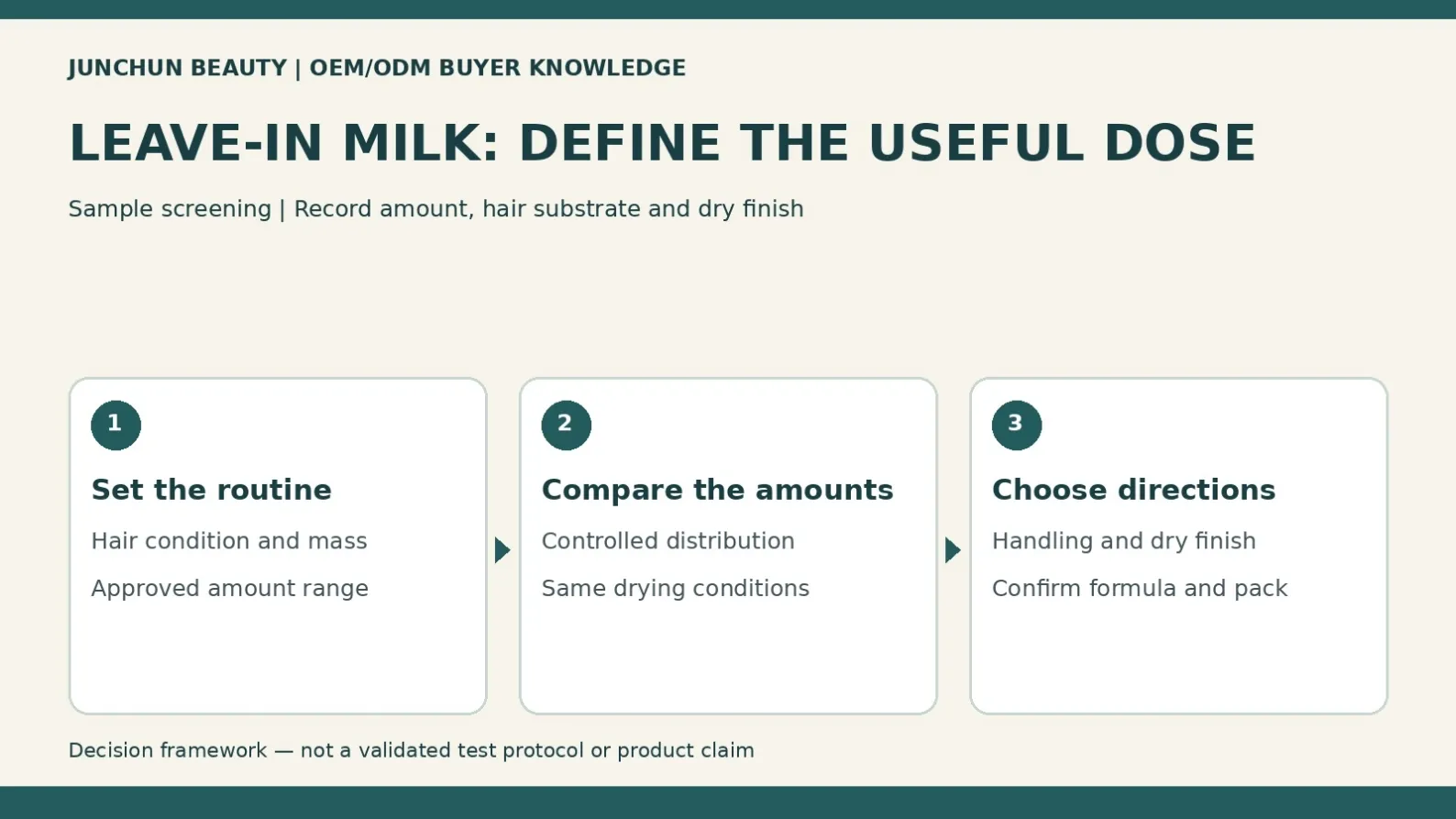
Screen leave-in milk within a supplier-approved amount range on defined hair substrates, then compare distribution, wet handling and dry finish. Choose directions that give the intended benefit without unwanted coating in the target routine. A sample that feels light at one unusually small dose does not establish a universally lightweight product.
Use current hydration positioning as context
Goldwell’s current hydration range explicitly includes a lightweight-feel position Goldwell official Pure Hydration range (Accessed 10 October 2026; page publication date not stated). This supports investigating sensory balance, not copying a competitor’s formula or claims. For a small private-label brand, the useful question is whether a candidate leave-in fits the amount and application pattern that customers will actually follow.
A milk that spreads easily can still leave an unwanted finish if too much is applied. Conversely, a very small amount can appear light while failing the intended handling task. Resolve this through a planned sample comparison. Do not instruct consumers to correct an unsuitable formula by guessing a much smaller portion.
Write the screen before handling the samples
Ask the supplier for the candidate’s application instructions and a reasonable screening range. Record hair substrate, initial condition, sample version and the amount applied. On tresses, record the substrate mass and treatment history. If comparing user routines, use a suitable reviewed plan rather than a casual safety or efficacy trial.
Select one main observation, such as distribution through the lengths or the desired dry feel. List additional observations separately. Keep the wash procedure, towel drying and drying method consistent. Do not increase heat or mechanical stress beyond the approved procedure to force a visible difference between samples.
Compare distribution and handling first
Use the agreed amounts and application area. Record whether the milk distributes with the planned number of passes and whether visible excess remains. If the buyer expects to use a pump, screen the actual filled pump as well as weighed laboratory portions. The directions should connect usable output to the approved application amount.
Describe wet handling with a common scoring sheet, and capture the evaluator, comparison and sequence. Avoid ranking samples only from immediate finger slip. An attractive first sensation may not match the final hairstyle. A separate instrumental detangling or breakage claim requires a suitable study, not this preliminary buying screen.
Allow the dry finish to decide between viable amounts
After a defined drying procedure, observe movement, unwanted coating, tack and the intended finish. Compare the same hair region rather than judging one sample at the roots and another at the ends. Photographs should use consistent lighting and styling; they are records, not automatic proof of a quantified shine or anti-frizz claim.
Include a planned follow-up observation relevant to the routine. A day-one finish may not describe second-day feel or repeated layering. If the format needs a companion styling product, record its identity and amount. Do not silently introduce another product to make an otherwise unsuitable milk appear better.
Translate the result into a purchasing decision
Approve the candidate only when the useful amount, pack output and directions are practical together. If acceptable performance exists only within an unrealistically narrow application window, discuss another existing formula or a development project. Packaging cannot resolve every sensory issue, and a newly changed formula requires a revised sample approval.
Confirm the formula reference, fragrance, fill size, label process and technical documentation in the quote. The 100-piece route is conditional on selected stable formulas and stock bottles. Treat the screen as a way to select a candidate and improve the brief. Stability, microbiological assurance and supported claims remain separate product-release requirements.
Sources and evidence limits
- Goldwell official Pure Hydration range — Accessed 10 October 2026; page publication date not stated. Brand product positioning, not sales data.
Buyer FAQ
What is the correct amount of leave-in milk?
There is no universal amount. Establish directions for the approved formula, pack and intended hair routine with the supplier.
Can one tress prove the product suits every hair type?
No. Use representative substrates and a reviewed evaluation plan for the intended users and claim scope.
Does a pleasant sample prove anti-frizz performance?
No. Sensory screening and supported anti-frizz claims require different evidence and defined conditions.
Can I dilute a rich sample to make it lighter?
Do not modify it yourself. Discuss another existing formula or a separately developed and reassessed version.
Related product routes and project contact
- Browse mature-formula product options
- Explore the leave-in hair spray product route
- Review OEM/ODM project examples
Contact the Junchun OEM/ODM team: Send your target hair substrate, leave-in routine, dispensing preference and quantity for a candidate-formula and sample-direction review. Business email: info@junchunbeauty.com.