
Low-MOQ Scalp Serum OEM: Compare Nozzle Delivery and Root Residue
Compare scalp serum OEM samples by sectioning, delivered dose, root residue and leakage, with clear cosmetic claims and stock-pack limits.
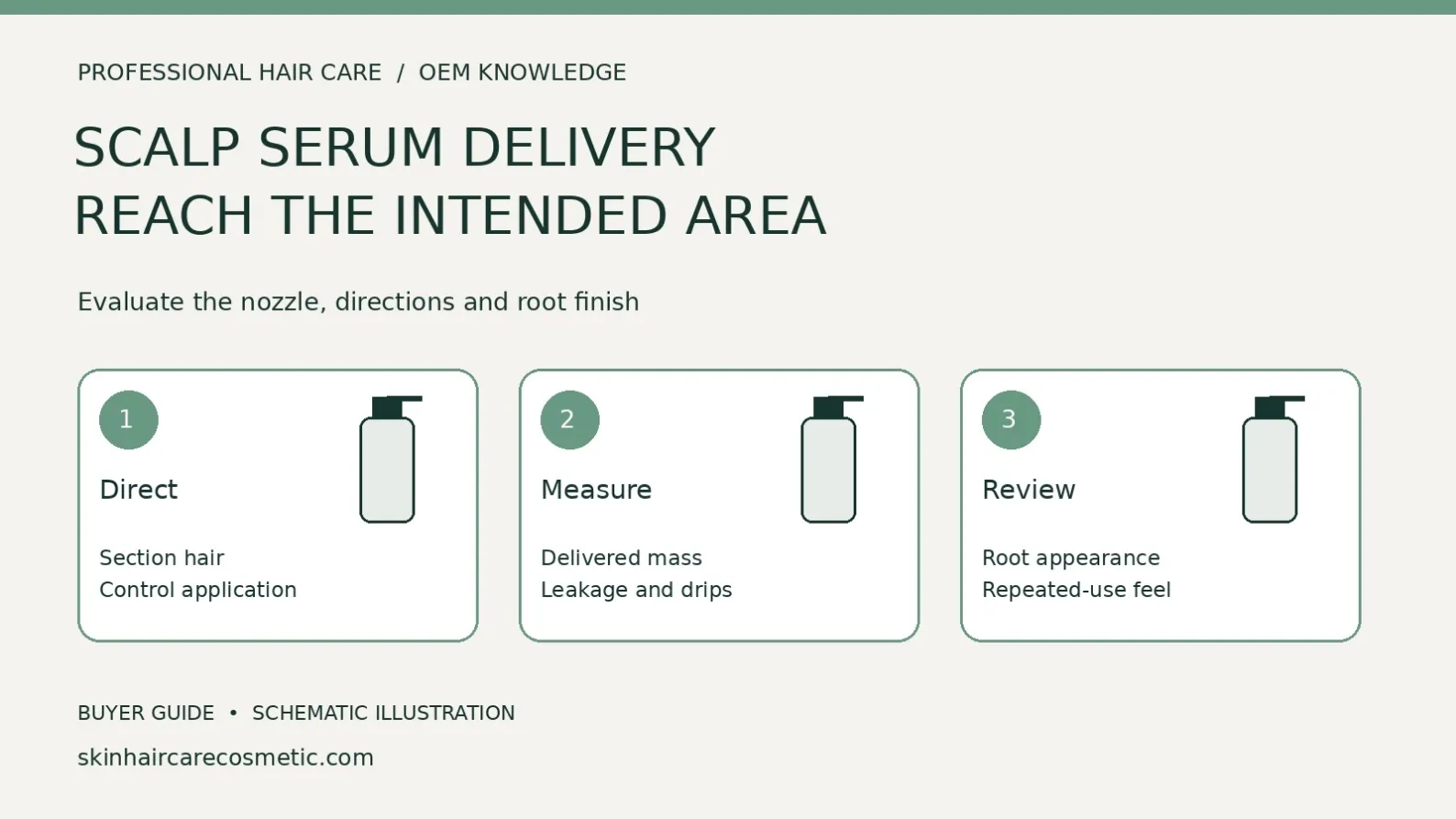
Direct answer
Choose a scalp-serum applicator by checking whether users can deliver the approved dose to the scalp with limited drips and unwanted root residue. Compare nozzle output, bottle handling, sectioning instructions and repeated-use finish with the actual formula. A convenient applicator can support a cosmetic routine, but it does not prove that a serum grows hair or treats a scalp condition.
Keep the product role clear
For the US, FDA identifies intended use as central to cosmetic or drug classification and lists restoration of hair growth among drug-claim examples. Source: FDA classification guidance, accessed 6 October 2026. This is a US-specific boundary, not a complete review of every destination market.
The practical opportunity considered here is a usable cosmetic scalp-care product. We have not verified a new October sales acceleration for scalp serums. A familiar ingredient story should therefore be evaluated on its own merits rather than presented as proof of a current market boom.
Define the approved application
Start with placement and routine. State whether the product belongs on clean dry scalp or another approved condition, how the user sections hair, and whether it remains on the scalp. A rinse-off pre-wash gel and a leave-on serum cannot share instructions simply because both use a pointed nozzle.
Record target hair density and the intended styling context. People wearing protective styles may need different access and handling instructions from people with a short cut. Design the instructions around observed usability rather than assuming one picture explains every routine.
Compare delivery with the actual formula
Weigh instead of counting drops blindly
Weigh the bottle before and after repeated applications following the proposed directions. Capture output variation and any accidental extra flow when the bottle is squeezed or tilted. For a dropper, specify how it is filled and emptied; a nominal drop count is not automatically a consistent mass.
Use multiple samples of the chosen component. Check the bottle at different fill levels. Record wet hands, grip and cap replacement where these represent normal use. These are proposed development checks, not published universal acceptance limits.
Observe scalp access and drips
A qualified usability review can observe whether the nozzle reaches the intended placement without scratching or uncomfortable pressure. The participant should follow the draft instructions rather than receive continuous coaching. Record missed sections, product on the hair instead of the scalp, drips and difficulty closing the pack.
If users need to squeeze hard, a low-viscosity formula may suddenly release too much. If flow is slow, users may repeatedly squeeze and exceed the intended amount. Diagnose the formula-component interaction before changing only the directions.
Score root appearance independently
Review shine, clumping, tack and perceived heaviness after drying and at the agreed later assessment. Include a baseline and consistent lighting. Keep hair styling and dose consistent between samples.
| Area | Record | Decision supported |
|---|---|---|
| Application | Output and misplaced product | Nozzle or instruction refinement |
| Drying | Tack and waiting time | Suitability for the intended routine |
| Hair roots | Greasy appearance or clumping | Cosmetic finish approval |
| Repeated use | Buildup before scheduled washing | Frequency and formula review |
Do not interpret cosmetic root appearance as follicle activity. A small application panel cannot establish prevention of shedding, reversal of greying or a biological scalp effect.
Review packaging and evidence together
Check closure leakage, transport protection and whether the nozzle can be cleaned as intended. Ask the laboratory and manufacturer to determine the preservation and microbiological assessment needed for the product and pack. A leak-free bottle is not evidence of microbiological protection.
Keep one approved formula version and component specification in the order record. Agree what happens if the stock nozzle becomes unavailable. Any substitute needs a review of delivery and relevant compatibility before it reaches customers.
An appropriate small-order route
Selected mature formulas using in-stock bottles may begin at 100 pieces per SKU. Confirm that the requested serum and applicator qualify; a custom scalp formula or special comb attachment is quoted separately. Review hair and scalp-care options and request a focused proposal rather than a generic catalogue promise.
Buyer FAQ
Is a nozzle always better than a dropper?
No. Compare actual access, dose control and user handling with the final formula.
Does a non-greasy finish establish hair growth?
No. It establishes a cosmetic sensory outcome only within the assessment conditions.
Can pre-wash gel directions be used for a leave-on serum?
No. Placement, contact time and removal instructions must match the approved product.
Does a 100-piece MOQ cover custom applicators?
The selected low-MOQ route uses mature formulas and in-stock bottles; custom components need separate confirmation.
Project discussion
Send the cosmetic product role, market, use frequency, preferred applicator, size and quantity through Contact. Ask for matched formula-and-pack samples and an application scorecard before accepting the stock route.