
Oct 12, 2026News & Insights
Protective-Style Scalp Spray: Test Access, Residue and Dry-Down
Evaluate a protective-style scalp spray with practical checks for nozzle access, measured dose, dark-hair residue and dry-down before a low-MOQ order.
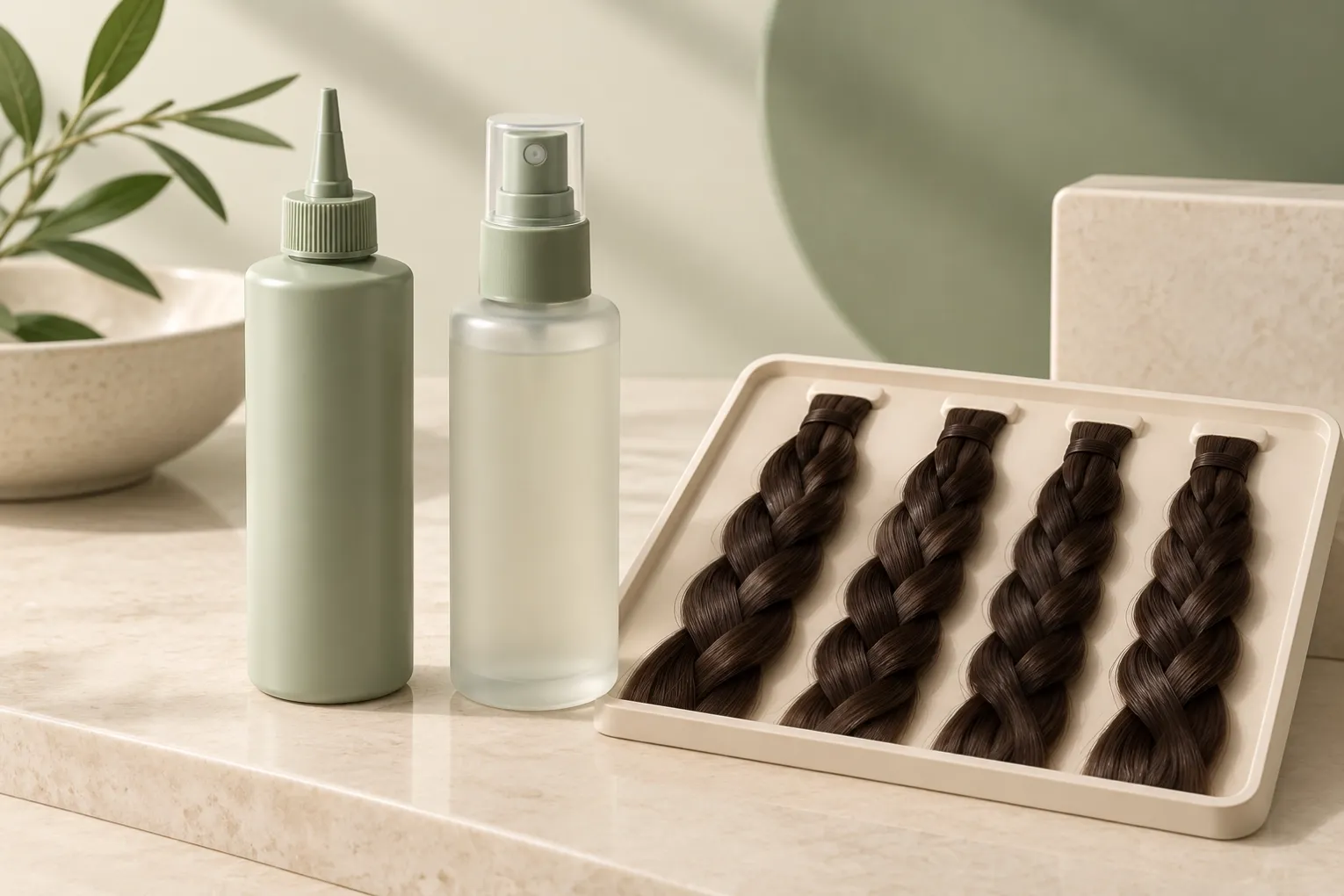
Test a protective-style scalp spray with the final dispenser on the intended braid or parting pattern. Compare dose, target access, hair wetting, dry-down and visible residue against a fixed benchmark. A fine mist and a precision nozzle solve different application problems; neither is automatically the better stock-packaging choice.
Why the application route deserves its own brief
A 7 October 2026 Byrdie feature, citing stylists and Instagram examples, emphasized continued scalp and natural-hair care during protective styling. This is editorial observation, not measured sales growth. See the dated feature.
Our procurement recommendation is to test the actual route to the target area rather than approve a bottle because it looks premium. A mist can coat the surrounding hair before reaching a narrow parting. A nozzle can place product precisely, but its flow may be excessive or difficult to spread.
Define the intended application
Specify whether the product is for exposed scalp sections, braided lengths or a between-wash refresh. These are different use locations and should have different directions. Record the hairstyle, braid spacing, hair density and usual styling products. Do not infer scalp suitability from a length-only hair test.
Keep rinse-off and leave-on formats separate. A pre-wash product may need removal, while a leave-on spray requires assessment of repeated use and cumulative residue. Avoid copying directions from another SKU.
Compare stock dispensers using the same formula
Check repeatable output
Prime each pump using the same procedure. Collect and weigh a predefined number of actuations, repeat the measurement and record variability. For a nozzle bottle, specify squeeze duration and orientation. Use a balance appropriate to the dose and keep the raw results.
Do not compare one spray with one squeeze as though they deliver equal quantities. Compare both at a controlled delivered mass and at their intended consumer dose.
Observe target access and overspray
Use a hairstyle model or suitable swatches for the initial screen. Apply along an agreed parting length, document distance and angle, and assess where the product lands. Record wetting of surrounding braids, pooling and handling difficulty.
A model screen identifies dispensing problems; it does not establish skin safety. Consumer or scalp-use evaluation needs a suitable safety review and supervised protocol.
Check residue and dry-down without promising zero
On dark hair swatches, take standardized photographs before application and after drying under fixed light. Compare one application and repeated layers without cleaning between them. Include any gel or edge-control product that users commonly layer with the spray.
Record drying conditions, product mass, transfer to a clean material and the agreed visual/tactile endpoint. “Feels dry” and “no visible white deposit” are distinct observations. Fragrance or a cool sensation does not demonstrate cleansing or odor elimination.
Approve the whole formula–bottle combination
The purchasing decision should cover leakage, closure security, spray consistency, label instructions and performance after the agreed storage checks. Retain the approved sample and component specification together.
For a selected mature formula and compatible stock dispenser, a trial route may begin at 100 pieces per SKU. Changing fragrance, suspended solids, viscosity or the pump can invalidate the original comparison and requires review. Confirm eligibility for the exact combination before quoting the launch.
Turn the results into honest product copy
Write narrowly: for example, describe targeted application if demonstrated by the dispenser study. Claims such as low visible residue need an agreed test and a defined use context. Avoid universal comfort, dandruff treatment, regrowth or a promise that every protective hairstyle responds identically.
Frequently asked questions
Is a fine-mist pump always best for braids?
No. A fine mist suits broader coverage, while a precision nozzle may suit narrow exposed partings. Test the final formula and intended style.
Can a hair swatch prove scalp safety?
No. Swatches help screen deposition and residue. Scalp safety and use suitability require an appropriate assessment.
Can we use a stock spray bottle for 100 pieces?
Selected mature-formula and compatible stock-packaging combinations may qualify. Confirm the exact pump, bottle and formula before ordering.
Does a cooling sensation prove the scalp is clean?
No. Sensory freshness is different from cleansing performance and should be described separately.
Related products and OEM capabilities
Discuss your project
Request a scalp-spray packaging review. Include the use location, hairstyle, target market, preferred dose and planned quantity; ask which mature formula and stock dispenser can be sampled together.
Sources and evidence notes
Byrdie: Fall 2026 protective styles — Published 7 October 2026. Stylist/editorial observations with Instagram references, not quantified demand.