
Scalp Foam or Liquid Serum? Compare Placement Before Choosing a Private-Label Format
Compare scalp foam and liquid serum by placement, spreading, runoff and dry-down. Use a controlled sample screen before selecting a private-label format.
Direct answer
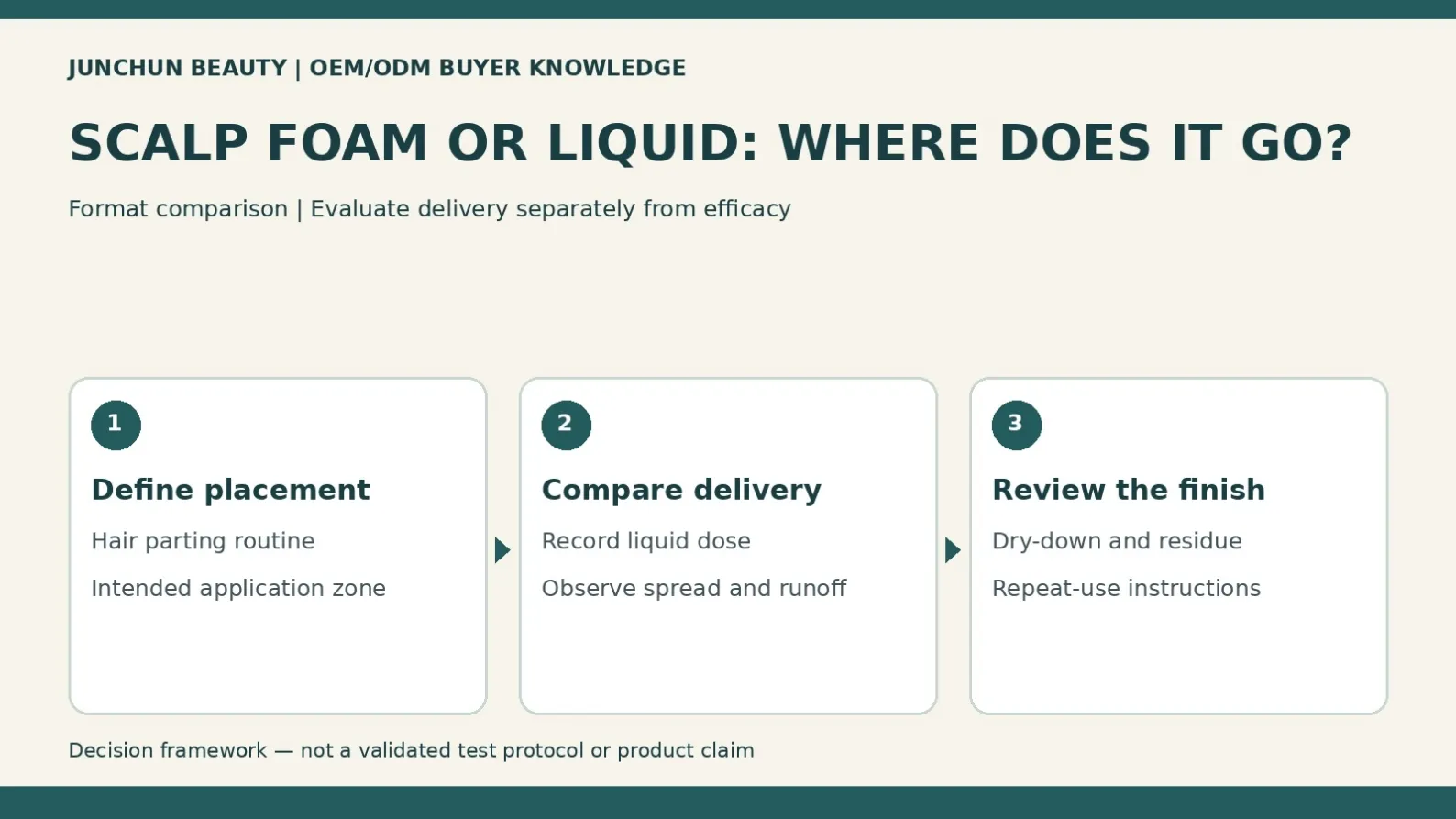
Choose scalp foam or liquid serum by how reliably the approved dose reaches the intended application area and fits the user’s routine. Compare spreading, runoff, hair wetting and dry-down using representative filled samples. Foam appearance alone does not show a higher active dose, better penetration or stronger cosmetic performance.
Why the format deserves a closer look
Dyson’s official product page presents a foam-to-serum scalp format Dyson official scalp bubble treatment (Accessed 10 October 2026; page publication date not stated). This confirms an existing commercial format; it does not establish that foam is universally preferable. A new private-label project must develop its own formula, pack, instructions and evidence rather than copying a branded treatment or importing its efficacy claims.
The practical opportunity is a delivery question. A buyer may want the product to stay near a hair parting before it spreads, while another needs a very direct liquid application. Those are different use cases. Decide what problem the format should solve before choosing ingredient stories or making a bubble transformation the central selling point.
Define a fair comparison with the technical team
Ask which existing liquid route is available and whether a foam route requires development. When formulas differ, record those differences and avoid describing the screen as a pure test of packaging. Have the supplier agree the amount and directions for each candidate. Equal-looking portions do not necessarily contain equal liquid quantities.
For delivery screening, ask the supplier to characterize dispensed output with an appropriate method. Record the number of actuations and the delivered product amount. Do not convert a foam volume into an assumed ingredient dose. The technical team should decide whether a shared base or another comparison design is practical and relevant.
Observe placement rather than judging bubbles alone
Use the defined parting and application zone, avoiding face and eye exposure and following approved directions. Observe where the product first lands, whether it spreads outside the intended area, and whether additional handling is needed. Start with a non-human delivery screen when appropriate; human-use evaluation requires suitable safety review and supervision.
Record hair wetting as well as scalp placement. A format can look tidy at first yet transfer a large amount to the surrounding strands. Include more than one relevant hair density or hairstyle in the approved evaluation plan. A demonstration on a single easily visible parting should not become a claim of suitability for all users.
Dry-down and repeat use can change the decision
Compare tack, residue and the handling effort needed after application. Separate an observer’s description from a tested claim such as non-greasy or residue-free. If users need to massage extensively or change their normal style, include that effort in the instructions and buying decision. Do not conceal an inconvenient routine with edited video.
Repeat the approved routine at planned checkpoints instead of judging only the first application. Record the existing styling products and wash schedule. If residue appears, refer it to the technical team before changing dose or directions. A more attractive foam may add no useful benefit if the liquid performs the required routine with fewer steps.
Choose a development route that matches a small pilot
A foam dispenser is not automatically available at the same MOQ as an existing liquid serum pack. Ask about component supply, filling suitability and product-specific compatibility. Selected stable formulas in stock bottles may start at 100 pieces; a newly developed foam or special pump needs a separate quotation and approval pathway.
Create a decision record with the intended zone, delivery observations, finish, instructions, documentation and component cost. Keep scalp cleansing, cosmetic conditioning and medical treatment purposes separate. No hair-growth, hair-loss treatment or clinical equivalence claim follows from a placement screen. Select the route with a meaningful routine advantage and a feasible release plan.
Sources and evidence limits
- Dyson official scalp bubble treatment — Accessed 10 October 2026; page publication date not stated. Evidence of an existing foam-to-serum format, not proof for an OEM formula.
Buyer FAQ
Does a bigger foam portion mean more active ingredients?
No. Compare delivered liquid quantity and the actual formula. Foam volume alone does not establish dose.
Can this comparison prove a scalp product works better?
It screens delivery and usability. Efficacy requires separate evidence for the finished formula and intended claim.
Can any existing serum be put in a foam pump?
No. The supplier must review formula suitability, component compatibility, dispensing and required product testing.
Will scalp foam always qualify for 100 pieces?
No. Confirm the exact existing-formula and stock-component route; development and special pumps may have different minimums.
Related product routes and project contact
- Browse mature-formula product options
- Compare the existing pre-wash scalp gel route
- Review OEM/ODM project examples
Contact the Junchun OEM/ODM team: Share scalp-care purpose, application zone, hairstyle, desired finish and quantity to compare an existing liquid route with a separately assessed foam concept. Business email: info@junchunbeauty.com.