
Small-Batch Body Cream OEM: Compare Jar and Pump Access Before Ordering
Compare body cream jars and pumps using filled samples, access, residual product and closure behavior. Keep stock-pack decisions separate from formula and safety approval.
Direct answer
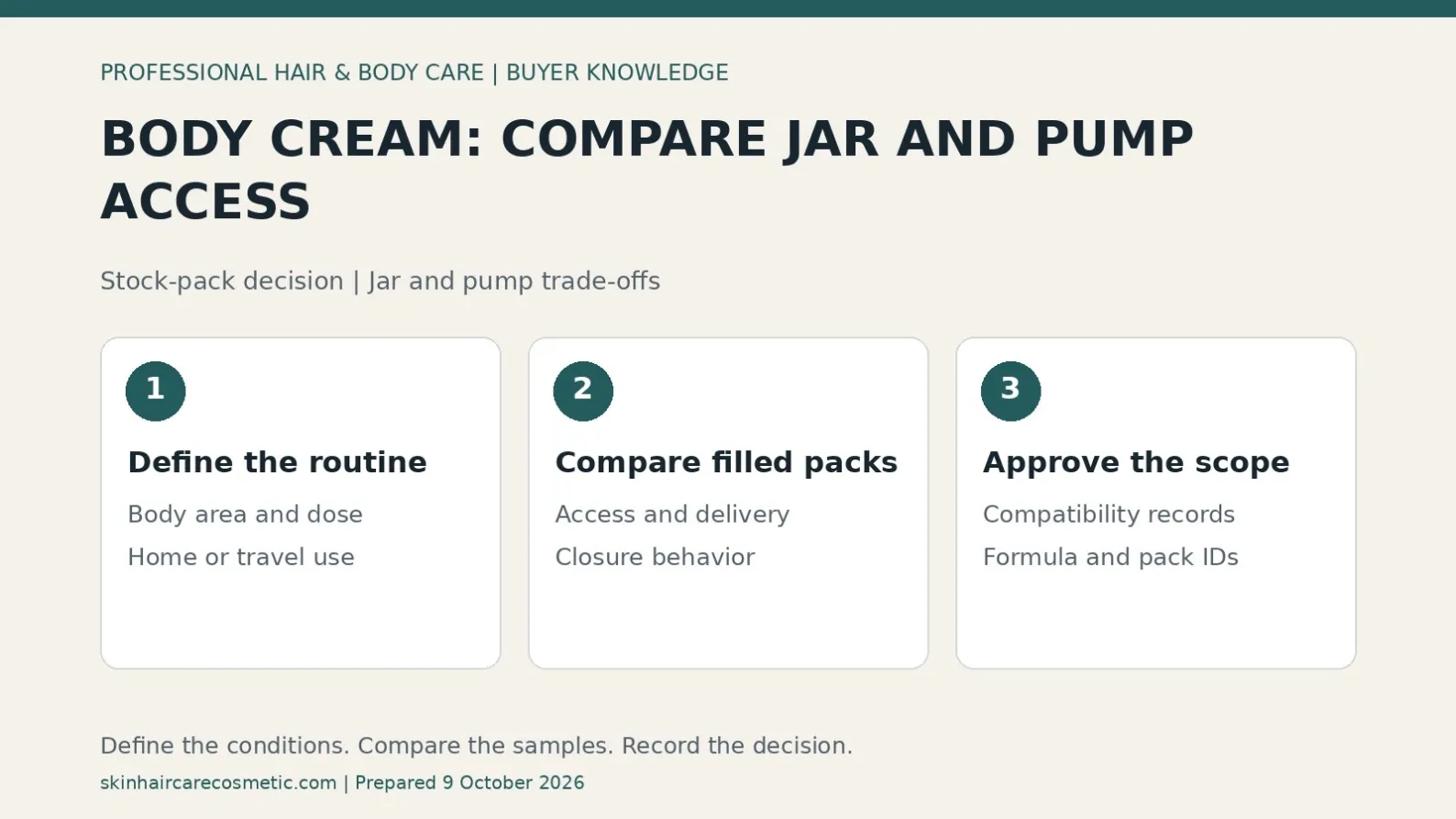
Compare the exact body cream in candidate stock packs, using a defined routine. Review access, controlled delivery, closure mess, leakage and residual product, then request appropriate compatibility and microbiological evaluation. Choose a jar or pump based on demonstrated usability and release requirements; neither format automatically guarantees hygiene, stability or a lower minimum order.
A pack decision inside a broader body-care opportunity
The organizer’s 3 October 2026 fragrance commentary discusses scent and personal identity. It is context for product positioning, not proof that a particular body cream or package will sell.
For a small brand, fragrance direction can make a range coherent, while pack access determines how the product is actually used. A customer may like the first sample and still stop using the product if obtaining the right amount is awkward. Evaluate the routine before turning a jar or pump into a central marketing promise.
Start with the existing formula rather than an empty pack
Confirm whether the candidate is an existing cream, a modified texture or a development sample. Ask the supplier which stock components are suitable for that formula and whether the filled combination has supporting records. An available bottle is not necessarily compatible with a richer product.
Define the intended application area, amount and frequency. Home use and travel create different handling questions. Identify what the user is expected to do when the contents run low. Do not prescribe technical acceptance limits from appearance alone; agree them with the supplier and the relevant reviewer.
Compare usability without ranking one format as universally better
| Question | Jar observation | Pump observation |
|---|---|---|
| Obtaining the intended amount | Access, portion control and rim mess | Output, priming and repeatability |
| Closing after use | Thread cleanliness and lid seating | Locking, cap fit or accidental actuation |
| Using remaining contents | Reach and practical retrieval | Recovery and residual product |
| Travel handling | Closure and leakage behavior | Lock integrity and leakage behavior |
Do not confuse access with microbiological assurance
A pump may reduce certain direct handling contacts, but its design alone does not establish the safety of a filled product. A jar also requires an appropriate formula, preservation approach and intended-use assessment. Request product-specific microbiological and compatibility review rather than announcing “contamination-proof.”
Follow approved use directions during the assessment. Do not add water, wash the inside of a filled pack or introduce improvised cleaning instructions. Evaluate external closure handling as a usability question. Any observed abnormal odor, appearance or packaging behavior should be recorded and referred to the technical team.
Evaluate the final filled configuration
Compare representative filled units and keep the formula version, fill amount and component references visible. Record texture, delivery, seal behavior and residue at planned checkpoints. Ask the supplier to design appropriate storage and transport checks for the product and destination. A short home-use screen does not establish shelf life.
If a stock pump cannot dispense the richer cream consistently, discuss another compatible stock component before changing the formula. If texture changes are proposed, treat them as development work with revised approval requirements. A different viscosity can change both sensory feel and dispensing suitability.
Make small-batch scope clear in the quote
The small-site offer starts at 100 pieces only for selected stable formulas using in-stock bottles. Body cream eligibility, jar availability, pump choices and decoration must be confirmed for the actual project. Do not assume that a quantity advertised for one product applies to every body-care configuration.
Compare total quoted scope, including formula, filled pack, label, carton and agreed documentation. An attractive container price can hide incompatibility or unusable residual product. Approve the product’s role, formula, pack and directions together, then use the pilot to gather handling feedback before extending the range.
Buyer FAQ
Is a pump always more hygienic than a jar?
Do not make a universal claim. Assess the complete formula, pack and intended use, including appropriate microbiological review.
Can a short pack trial establish body cream shelf life?
No. It can reveal usability issues. Shelf-life and compatibility conclusions require suitable technical evidence and defined conditions.
Does every body cream qualify for 100 pieces?
No. Selected stable formulas and stock packaging may qualify. Confirm the specific formula, pack and customization scope in writing.
Should a richer cream be diluted to work in a pump?
Do not modify the sample yourself. Ask the supplier about another compatible pack or a separately developed and reassessed formula.
Related product routes and project contact
Use the catalogue and project examples to discuss an existing body-care route and available stock components, with eligibility confirmed for your project.
Contact the Junchun OEM/ODM team: Share target country, cream texture, use routine, preferred size, fragrance route, jar or pump preference and quantity.