
Small-Batch Body Mist OEM: Match Spray Quality to the Formula Before Ordering
Match a body mist formula to its stock sprayer before a small OEM order. Compare spray output, drying feel, leakage and package compatibility with coded samples.
Direct answer
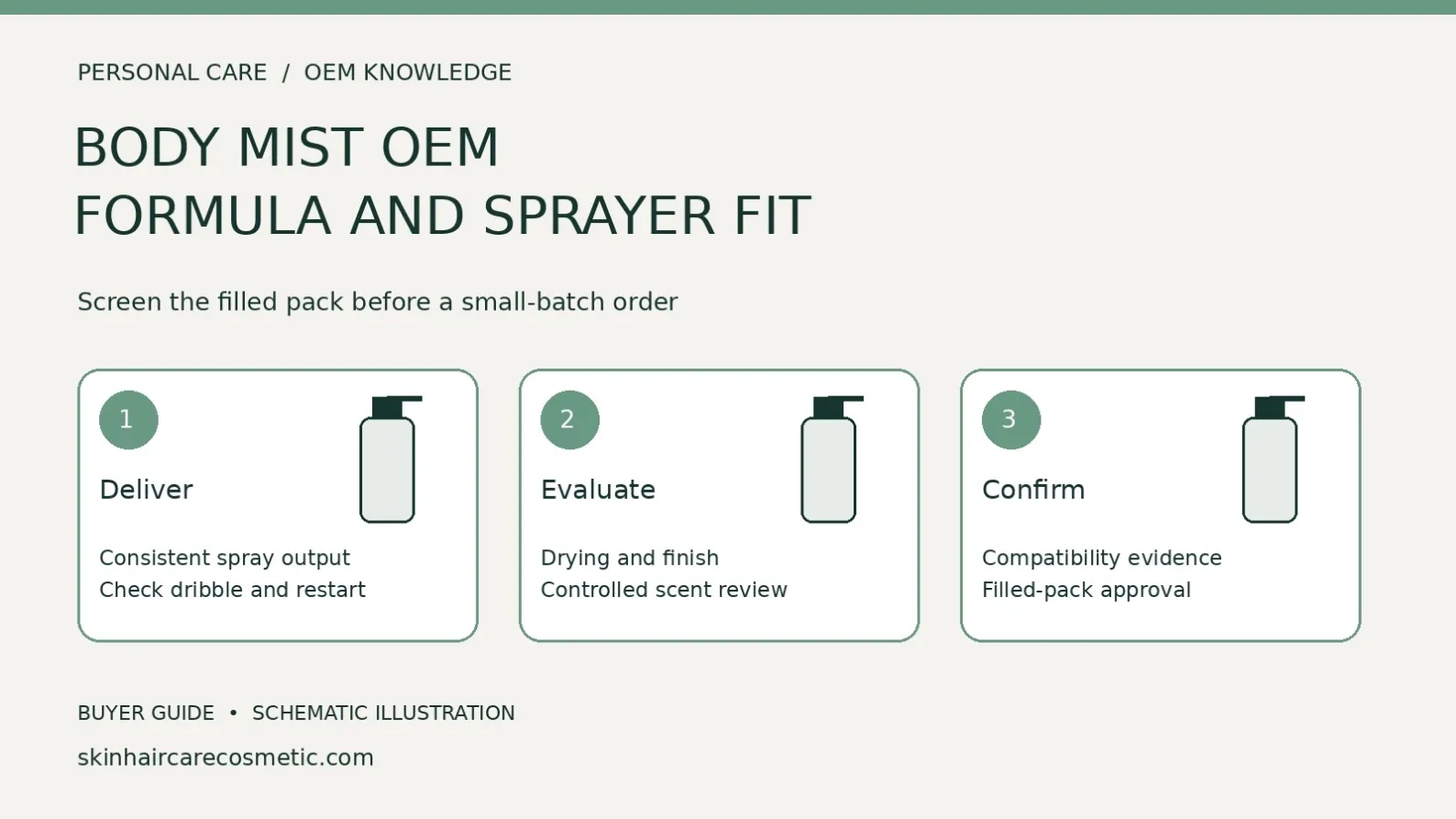
Test a body mist as a filled package: formula, bottle, closure and sprayer together. Compare output consistency, spray placement, drying feel and leakage, then request appropriate compatibility and safety work. Choosing a scent from a blotter or selecting an attractive stock bottle is not enough to approve production.
A verified product-format signal
The current e.l.f. body-mist listing, checked on 8 October 2026, presents a fragrance mist within its POP Tromsø collection. This confirms a live body-care format and seasonal positioning. It does not establish sales, market share or a formula available for another brand to copy.
For an OEM buyer, the useful inference is to evaluate whether an original fragrance mist fits the brand's channel and manufacturing brief. That is a product opportunity to assess, not a conclusion that every small brand should launch one.
Write an original mist brief
Describe intended use area, sensory finish, scent direction, capacity and price position. Specify the target country and retail channel. If the brand wants a hair-and-body product, assess that broader use deliberately; body-only instructions and evidence should not be reused without review.
A fragrance name and mood can guide development, but do not ask for another brand's exact perfume, label or visual identity. Set your own balance between fragrance expression, drying experience and skin feel. Avoid promising long-lasting scent duration before testing the final product.
Compare sprayers with the same formula
Start with bottle and closure information: material, fill volume, component references and intended transport route. Evaluate the proposed filled pack rather than an empty demonstration bottle. Have the development team confirm that handling and storage conditions are appropriate for the formula.
For delivery checks, record output over a defined number of actuations, the initial priming behavior, restart after standing and any dribble. Keep the collection method consistent. Observe the usable spray pattern at an agreed distance; do not judge quality from an edited spray photograph.
Keep acceptance questions distinct
| Check | What it tells you | What it does not prove |
|---|---|---|
| Repeated spray output | Whether dose delivery is reasonably consistent under the method | Skin tolerance or scent longevity |
| Priming and restart | Whether users may struggle at first use or after storage | Full transport performance |
| Drying and finish | Sensory response under an assessed use protocol | Universal non-staining performance |
| Filled-pack compatibility | Behavior of the selected formula and components | Compatibility with every substitute pump |
Set acceptance criteria before comparing samples. Do not declare a universal spray-output tolerance; the target depends on your use directions and selected component. A supplier's internal pack specification should be made clear enough for approval and routine inspection.
Add the relevant compatibility work
Ask the qualified team to assess formula-pack interaction, visible changes, leakage, closure performance and stability across the intended storage and distribution conditions. Keep the protocol and result tied to the exact components. A different gasket, actuator or bottle material can require review even if the outside appearance is similar.
If your intended directions involve potential contact with clothing, establish a suitable test plan using relevant materials and conditions before making a non-staining statement. Do not infer fabric performance from clear appearance in a bottle. Keep use guidance conservative until evidence supports a broader claim.
Approve the trial without overpromising MOQ
Small-batch routes depend on formula maturity, component availability, decoration and project requirements. Selected mature formulas with stock bottles may support 100-piece orders where confirmed; this is not a universal mist MOQ or a promise for custom fragrance development.
Confirm sample costs, included tests, documentation, labeling and logistics separately. Keep the approved scent reference and filled pack, and identify changes that require reapproval. Short shelf-life or safety claims must never be invented to speed the launch; use the supported product records.
Buyer FAQ
Is a body mist suitable for hair automatically?
No. Intended use, formula, directions and evaluation must cover hair use before presenting it as a hair-and-body product.
Can I approve a sprayer using water only?
A water demonstration may show basic operation, but production approval should assess the actual formula in the selected pack.
Does a clear body mist guarantee no fabric marks?
No. Fabric performance depends on the final formula, material and exposure and requires an appropriate test if claimed.
Is an alcohol-free mist always the better option?
No universal choice applies. Compare the intended sensory finish, fragrance delivery, preservation, packaging and assessed use requirements.
Project discussion
Browse the personal-care catalogue, then send your original scent direction, use area, capacity, country and estimated quantity through Contact. Request confirmation of a suitable formula, stock sprayer and filled-pack evaluation scope before budgeting a small order.