
Small-Batch Body Wash OEM: Test a Seasonal Scent Before Expanding the Range
Test a seasonal body wash concept through rinse-off scent, formula compatibility and pilot economics before committing to multiple fragranced SKUs.
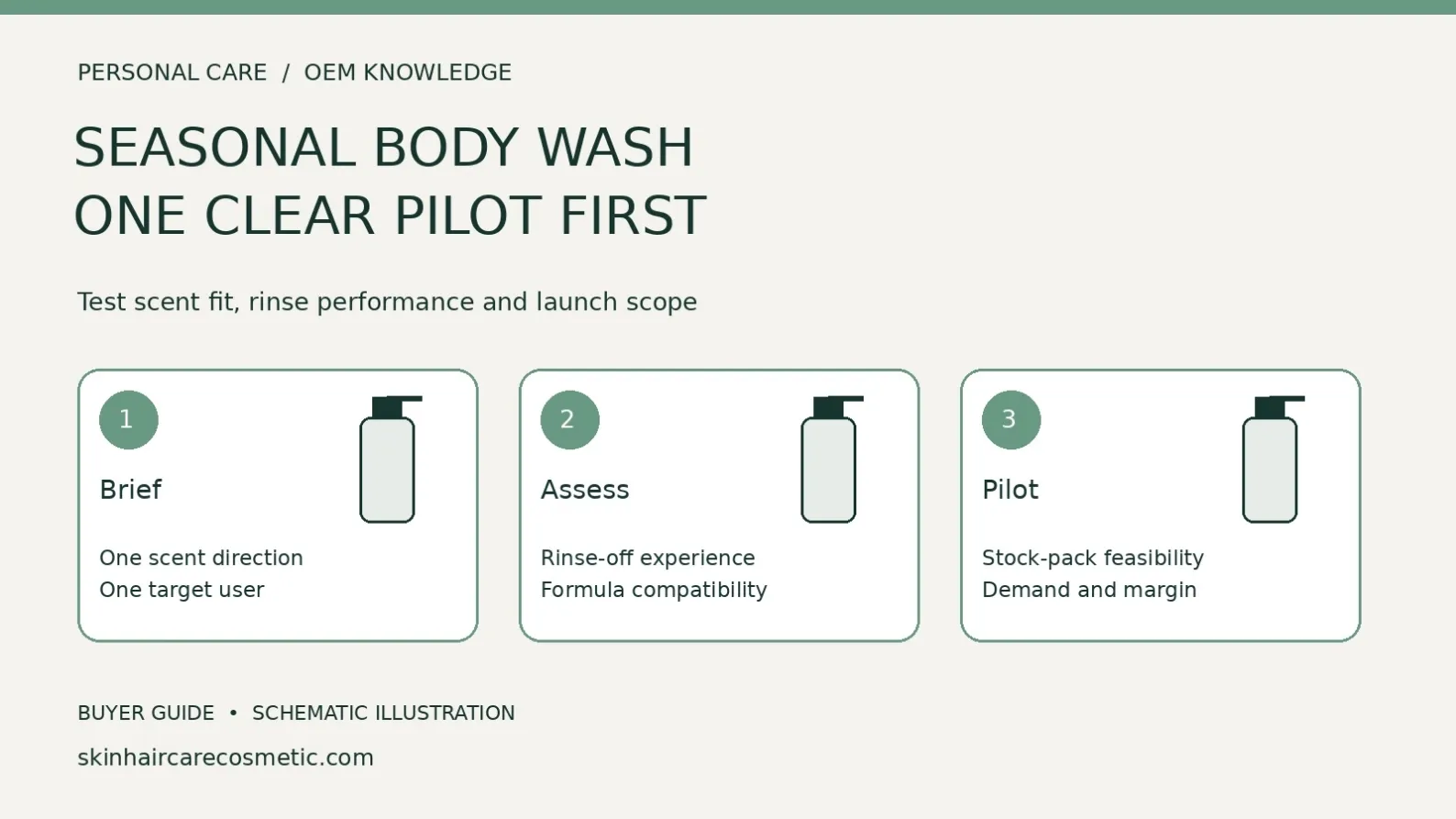
Direct answer
Test a seasonal body-wash idea with one clear scent brief and the final rinse-off formula before launching a coordinated range. Evaluate lather, rinse, fragrance perception and packaging compatibility alongside the economics of a small order. A successful fragrance in a leave-on cream or mist does not automatically make a successful body wash; the use conditions and product role are different.
The recent signal and its limits
On 5 October 2026, e.l.f. announced a holiday fragrance mist, body cream and travel kit. Source: brand release. That is a verified scented body-care launch, not a body-wash launch or proof that seasonal fragrance will sell in every market.
Our inference is that a smaller brand can investigate a limited scent extension without copying the named collection, artwork or formulation. The commercial uncertainty is whether its own customers value the scent enough to buy and use the product after the first promotional exposure.
Write a usable fragrance brief
Describe the intended impression, strength and use moment. Specify whether the fragrance should be noticeable during the shower, faint after rinsing, or part of a broader routine. Avoid treating a descriptive mood name as a measurable performance requirement.
Provide acceptable and unacceptable references to the development team. A benchmark is for describing direction, not requesting a counterfeit. Review preferences with actual target-market buyers: the same seasonal story may not suit a hot-climate daily cleansing range or a fragrance-sensitive audience.
Define the formula route before choosing many scents
Ask whether the proposal uses an existing mature fragranced formula, a new fragrance in an established base, or fully custom development. Changing the fragrance is still a change to the finished product and may require new compatibility, safety and preservation review. It should not be represented as a simple label change.
For selected mature formulas using in-stock bottles, projects may begin at 100 pieces per SKU. Do not assume that a newly requested perfume qualifies. Confirm available scents, component stock and evaluation scope in writing.
Compare the rinse-off experience
Assess the approved samples under consistent dose, water and rinse conditions. Record fragrance impression in the bottle, during lathering and after rinsing separately. Keep the panel safe and appropriate to the intended use; the assessment should follow the agreed product safety review.
| Stage | Question | Procurement decision |
|---|---|---|
| Bottle opening | Is the scent balanced and acceptable? | Initial scent selection |
| Lathering | Does the fragrance fit the cleansing experience? | Formula-scent alignment |
| Rinsing | Is removal comfortable and practical? | Routine and usability approval |
| After drying | Is the remaining scent appropriate? | Final positioning and directions |
A strong scent in the bottle is not proof of lasting scent on skin. Avoid time-based persistence claims unless the finished product has been evaluated for that wording. Keep cleansing assessment separate from fragrance preference so the panel does not overlook a poor rinse because it likes the perfume.
Check changes in the finished product
Compare color, appearance, viscosity, scent and relevant specifications during the agreed stability program. Include the proposed bottle and closure. Review pump output and label contact where the chosen formula can affect handling.
Ask the supplier and laboratory which preservation checks are needed. ISO 11930 addresses evaluation of cosmetic antimicrobial protection; it is not a scent test. Source: ISO 11930:2019 overview, publication January 2019, accessed 6 October 2026. The applicable assessment must be selected for the specific formulation.
Keep the pilot decision manageable
Choose one pack size and one formula direction first. Record effective selling price, delivered orders, complaints and feedback about repeated use. Separate fragrance dislike from leakage, cleansing dissatisfaction and unclear instructions. Each problem suggests a different action.
A limited seasonal sell-out may reflect a small starting inventory. It does not establish demand for a permanent multi-SKU line. Decide whether to retain the wash, adjust the scent or discontinue the seasonal concept before adding cream, mist and gift packaging.
Review body-care development options and specify which product role you need. Availability, final claims and the small-order route remain subject to the actual proposal.
Buyer FAQ
Can a mist fragrance be added unchanged to body wash?
Do not assume so. The finished rinse-off formula requires its own compatibility and use review.
Does 100 pieces include any custom fragrance?
No. It applies to selected mature formulas in stock bottles; new fragrance work is separately confirmed.
Does a holiday launch prove year-round demand?
No. Validate your customers' repeated use and commercial response outside the initial offer.
Can the scent claim to improve sleep?
Avoid a therapeutic promise in a cosmetic brief. Review intended claims for the destination market.
Project discussion
Use Contact to send the target country, body-wash role, scent direction, pack size, quantity and launch window. Request available mature-formula options first, then agree the work needed for any fragrance change.