
Sulfate-Free Shampoo OEM: A Practical Plan for Foam, Viscosity and Fragrance
Brief sulfate-free shampoo development with foam, measured viscosity, fragrance compatibility and final-pack delivery targets before approving samples.
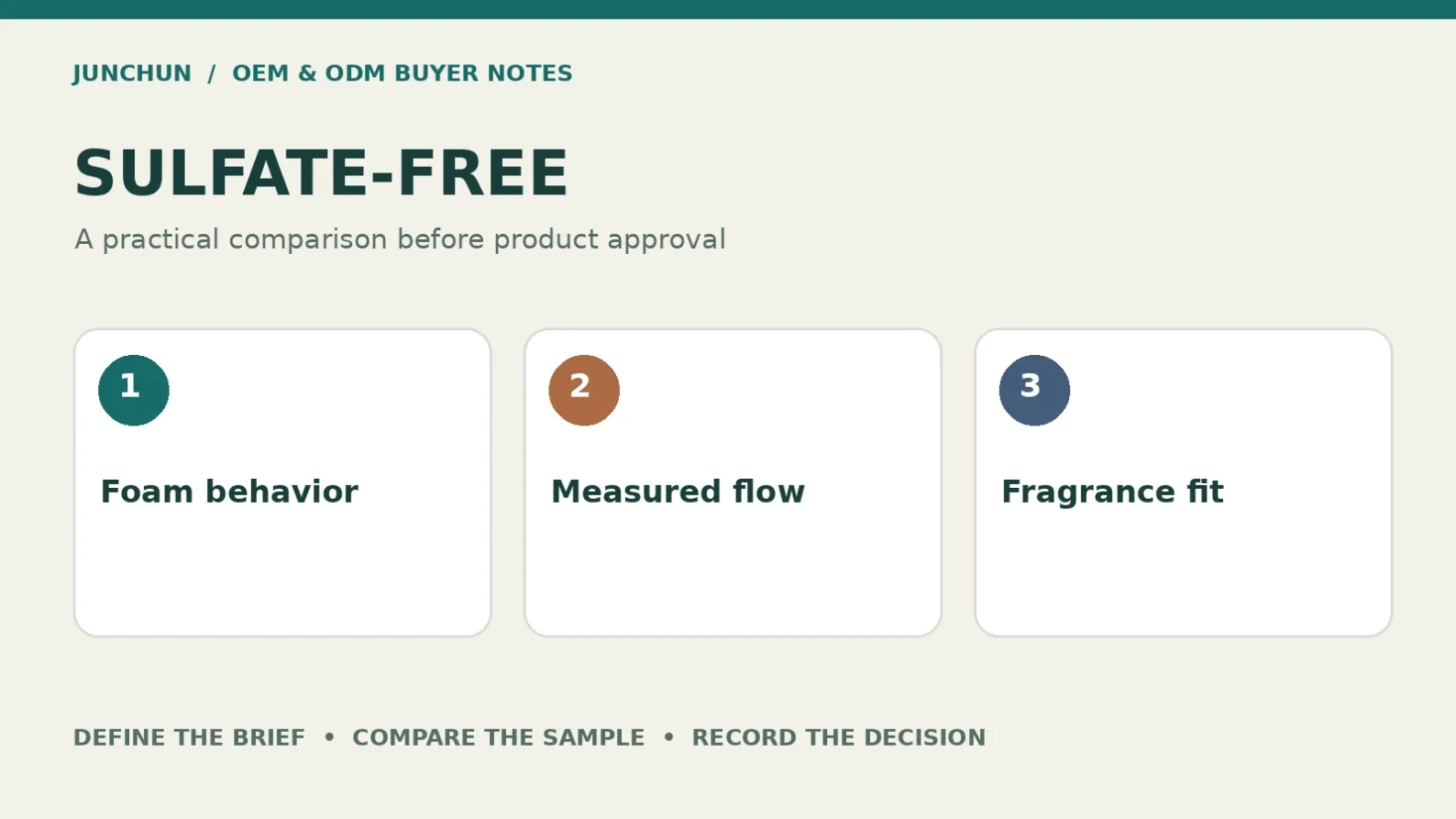
A useful sulfate-free shampoo brief specifies cleansing feel, foam behavior, viscosity measurement conditions and the approved fragrance version. The absence of sulfates is a composition criterion; it does not replace evaluation of the complete formula.
Start with the whole formula
Colonial Chemical publishes a sulfate-free shampoo starting formulation that identifies separate cleansing, viscosity-building and fragrance components. It is a development example, not a validated substitute for a manufacturer’s finished product. Buyers should request the proposed INCI list and define the intended exclusion claim precisely. Review marketing wording for the destination rather than treating “free from” as a universal quality ranking.
Distinguish foam from the wash result
Use approved directions and compare samples on relevant hair under consistent wetting, dose, water and buildup conditions. Record foam onset, distribution, rinsing and dry-hair feel separately. A shampoo that gives more visible foam is not automatically the better cleanser or the more comfortable formula. If the commercial target is hard-water use, include the intended local water conditions in the test brief and record them.
Specify how viscosity is measured
Ask the laboratory to record the instrument, spindle or geometry, speed, temperature, sample preparation and equilibration time. Agree the specification only after the intended pack has been evaluated. A number without measurement conditions is difficult to compare across suppliers. Include dispensing, stringiness, drips and recovery after storage in the pack review. Do not adjust a production formula by adding salt or thickener on the buyer’s own initiative.
Recheck after choosing the fragrance
Compare the approved base and the final fragranced version using the same measurement conditions. Track clarity or appearance, odor, viscosity, pH and any separation through the technical team’s stability plan. Changing fragrance or its concentration is a version change that needs review. The final closure should also be checked for leakage, output and formula contact. A fragrance sample smelled on a blotter cannot establish finished-shampoo compatibility.
Write a sample decision that can guide production
Use a scorecard with mandatory acceptance criteria and preference scores kept separate. An incorrect exclusion claim, failed technical release or incompatible pack should not be averaged away by good fragrance scores. Record formula version, fragrance code, packaging components and approved directions. Request the existing-formula route and a separate custom route if the requested foam or sensory profile requires redevelopment.
Buyer FAQ
Does sulfate-free mean low foam?
No. Evaluate the actual surfactant system and use conditions rather than assuming foam behavior from the claim.
Is thicker shampoo more concentrated?
Not necessarily. Viscosity and active content are separate specifications.
Can I change the scent after approval?
Treat it as a formula change and review compatibility, documentation and sample approval again.
References and project links
- Colonial Chemical starting-formula example, accessed 2 November 2026
- Lightweight conditioner for routine comparison
- Discuss samples and specifications
Send your target market, sales channel, product requirements, packaging and quantity to info@junchunbeauty.com for a project-specific sample and quotation review.