
Jun 26, 2026News & Insights
We Didn’t Start with a 4-Step System — We Ended Up There Because Single-Step Results Weren’t Consistent
We Didn’t Start with a 4-Step System — We Ended Up There Because Single-Step Results Weren’t Consistent When we first worked on this type of treatment, the idea was actually quite simple. Most clients
We Didn’t Start with a 4-Step System — We Ended Up There Because Single-Step Results Weren’t Consistent
When we first worked on this type of treatment, the idea was actually quite simple.
Most clients were asking for something straightforward:
- smoother hair
- less frizz
- no complicated process
So naturally, the focus went to one thing:
👉 make the “treatment step” stronger.
In other words, if Step 2 performs well enough, everything else should fall into place.
But that’s not what happened.
The Same Product, Completely Different Results
After some time in the market, a pattern started to show up.
The exact same product:
- worked beautifully in some salons
- but gave unstable results in others
We saw feedback like:
- “It looks great the first day, but doesn’t last”
- “Hair feels coated, but still dry underneath”
- “Different stylists get different outcomes”
At first, this was often attributed to technique.
But when the same feedback came from multiple countries and experienced salons,
it became clear:
👉 this wasn’t just about application.
The Real Issue Wasn’t the Treatment — It Was the Process
Most systems in the market rely heavily on a single step to do everything:
- cleanse
- repair
- smooth
- seal
That’s a lot to ask from one product.
Hair, especially chemically treated hair, doesn’t respond well to that kind of “one-step solution.”
If the preparation is inconsistent,
absorption becomes unpredictable.
If there’s no control after treatment,
results can feel heavy or unstable.
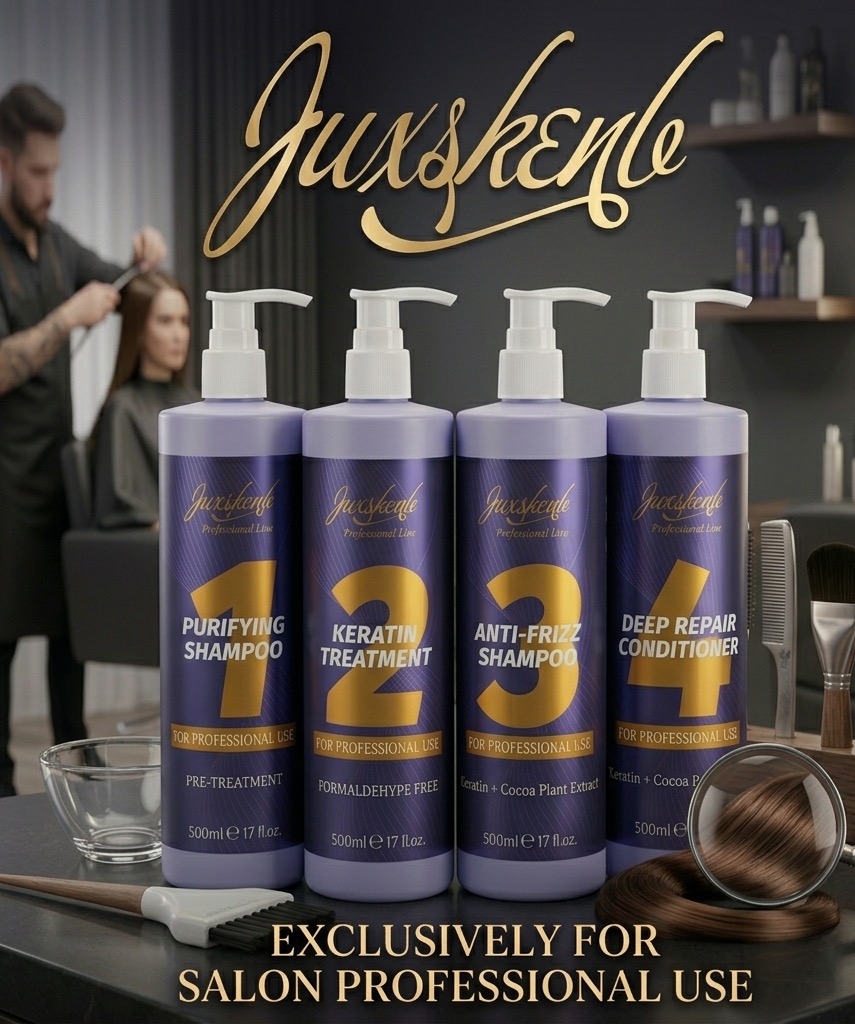
That’s How the 4-Step Structure Came In
Not as a marketing upgrade — but as a correction.
Each step was separated to solve a very specific problem.
Step 1 — Purifying Shampoo
Not just cleaning, but standardizing the starting point
→ removes buildup and allows even cuticle opening
Step 2 — Treatment (Keratin / Botox stage)
This is still the core
→ but now it works on a more predictable foundation
Step 3 — Anti-Frizz Control
This is often overlooked in simpler systems
Without this step:
- hair can feel too heavy
- or overly coated
This stage balances the result instead of just adding more product
Step 4 — Deep Repair Conditioner
This is where the result stabilizes
Not just softness — but durability
What Changed in Real Salon Use
Interestingly, the biggest improvement wasn’t just “better results.”
It was:
👉 more consistent results
- junior stylists could achieve similar outcomes
- less variation between clients
- fewer unexpected reactions on bleached hair
A Comment That Stuck With Us
One salon owner said something that summarized it well:
“We can achieve good results. What we need is repeatable results.”
That difference is what separates a product from a system.
Final Thought
The market doesn’t necessarily need stronger formulas.
It needs processes that reduce uncertainty.
And that’s why more salons are gradually moving away from
“single treatment products” toward structured systems.